Machine Traces of Discovery Path #4 - Lab Notebook
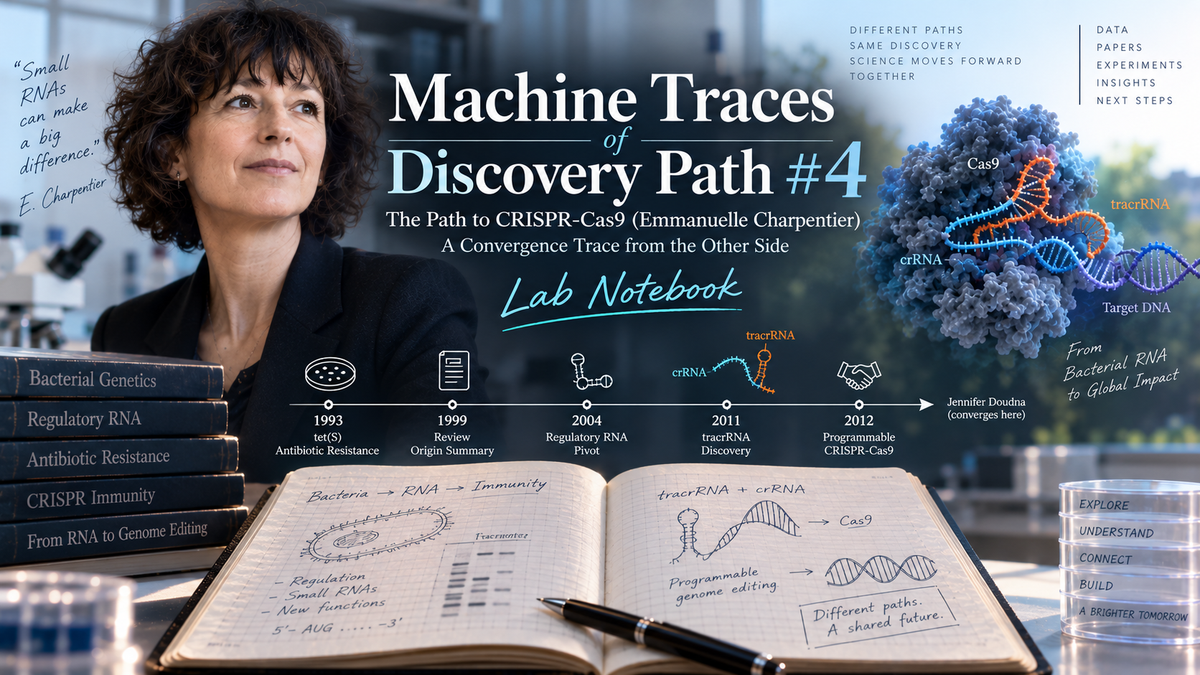
Disclaimer — Discovery Trace Series. The Discovery Trace series is an experimental series of articles attempting the semi- or fully-automatic reconstruction of the paths to major discoveries. Multiple AI tools have been deployed to reconstruct each "Discovery Path." To evaluate the progress of the technology, an initial set of articles is published prior to rigorous verification, and may therefore contain errors and omissions. Content will be updated as corrections are made, with notes on publication history and a correction log.
A convergence trace: the same discovery as #3 (Doudna), reconstructed from Charpentier's side. The two independently-built paths meet at one shared node — the 2012 Cas9 paper (M5 = #3's H9). This notebook holds Evidence 1 (per-paper full-text精読). Evidence 2 (chain), 3 (reduction), and 4 (coverage) follow.
Scope rule. A path is a property of one person. Every node below is Charpentier-authored. Jennifer Doudna is a co-discoverer (her own path is #3); the CRISPR-immunity pioneers (Mojica, Jansen, Barrangou/Horvath, Brouns, Marraffini/Sontheimer, Garneau, Šikšnys/Gasiūnas) are influences, not nodes. Collaborators credited where they carry a transfer (Vogel = dRNA-seq method; Chylinski = person across M4→M5).
Nodes. M1 (1993, Gene, tet(S)) → M1-review (1999, AAC, origin summary) → M2 (2004, Mol. Microbiol., regulatory-RNA pivot) → M4 (2011, Nature, tracrRNA discovery) → M5 (2012, Science, Cas9 — the landmark, read in #3 as H9; not re-transcribed here). (M3, Makarova 2011 classification review, is consortium context, not a core node.)
Honest coverage note (read before trusting a quote). M2 (Mangold 2004) and M4 (Deltcheva 2011) are clean born-digital PDFs read at full text; quotations are verbatim. M1 (1993 Gene) has an imperfect embedded OCR text layer — the gene name "tet(S)" is garbled ("ret/let/trt(S)") and "BM4210" appears as "BM42 10". Those two artifacts were silently corrected and any fixed quote is tagged (OCR-corrected); wording that could not be confirmed verbatim is tagged (OCR-uncertain). Where the source is silent on a protocol value it is tagged [S]/[M], never imputed.
Evidence-1 totals. 3 papers精読 (M1, M2, M4); ~19 experiments; 50+ [P] printed values; 27 [S]/[M] gaps (exact per-paper counts to be tabulated in the Evidence-4 coverage table). (M5's mechanism-level evidence lives in the #3 Lab Notebook, H9.)
M1 — tet(S): a new ribosome-protection tetracycline-resistance gene from Listeria monocytogenes
Charpentier E, Gerbaud G, Courvalin P. "Characterization of a new class of tetracycline-resistance gene tet(S) in Listeria monocytogenes BM4210." Gene 131(1):27–34 (1993). PMID 8370538. DOI 10.1016/0378-1119(93)90665-P. (Charpentier = first author)
The question this paper set out to answer — The multiply-resistant L. monocytogenes clinical strain BM4210 carried a tetracycline (Tc)–minocycline (MC) resistance determinant on the self-transferable plasmid pIP811 that did not hybridize with any of the four tet gene classes then known in Gram-positive bacteria. What is this determinant — its sequence, its encoded protein, its likely mechanism, and how widely is it distributed among Tc/MC-resistant pathogens? The paper set out to clone, sequence, and characterize this apparently novel resistance gene, and to place it within the emerging molecular taxonomy of tet determinants.
Experiments and results
M1.1 — Cloning and localization of the resistance gene
- What was done: pIP811 DNA cut with ClaI was ligated into AccI-cut pUC18 and transformed into E. coli JM83; transformants were selected on ampicillin + tetracycline, screened by lysate agarose gels, restriction-mapped, and the insert was subcloned with BglII/EcoRI/HindIII to localize the resistance region.
- What came out: The smallest TcR hybrid plasmid, pAT451, carried a 4.5-kb insert; subclones cut at the internal BglII/EcoRI/HindIII sites all lost TcR, placing those sites inside the region essential for resistance expression.
- Evidence: "The smallest hybrid plasmid obtained, pAT451, was shown to contain a 4.5-kb insert" (OCR-corrected)
M1.2 — Nucleotide sequencing and ORF identification
- What was done: A 2732-bp fragment spanning the TcR region was sequenced on both strands by the dideoxy chain-termination method (Sequenase, [α-35S]dATP), using universal and synthetic oligo primers; start/stop codons in all six frames were mapped and upstream regulatory motifs analysed.
- What came out: A single 1923-bp ORF from a TTG start (nt 447) to a TGA stop (nt 2370) encoding a 641-aa protein of calculated Mr 72,912, named Tet(S); preceded by a Gram-positive-type RBS, a candidate −35/−10 promoter, and 16-bp inverted repeats resembling the tet(M) regulatory region.
- Evidence: "a coding sequence of 1923 bp, corresponding to a protein with a calculated M, of 72 912" (OCR-uncertain)
M1.3 — Amino-acid sequence comparison / mechanism inference
- What was done: The deduced Tet(S) sequence was screened against the NBRF protein database (Lipman–Pearson algorithm) and aligned pairwise (Wilbur–Lipman) with other Tet proteins and with translational factors.
- What came out: Tet(S) showed 79% and 72% aa identity to Tet(M) and Tet(O) (40% to Tet(Q)), and its N-terminal ~150 residues matched EF-G/EF-Tu/IF-2 GTP-binding motifs — placing tet(S) in the ribosome-protection class and suggesting a GTP-binding, elongation-factor-like mode of action.
- Evidence: "The ret(S) gene product exhibits 79 and 72% amino acid identity with Tet(M) from Streptococcus pneumoniae and Tet(0) from Campylobacter coli" (OCR-uncertain)
M1.4 — In-vitro transcription–translation of the gene product
- What was done: Proteins specified by pUC18 and the recombinant plasmids were made in an E. coli cell-free coupled transcription-translation system, [35S]Met-labelled, resolved by SDS-PAGE, and autoradiographed.
- What came out: pAT451 (TcR) specified a 68-kDa protein (D) absent from Tc-sensitive subclones — matching the 72,912-Da calculated Tet(S) — plus a 48-kDa protein (C) likely from a secondary internal GTG start; the observed 68 kDa agreed with the predicted size and with Tet(M)/Tet(O).
- Evidence: "Plasmid pAT451 specified two polypeptides, C and D, of 48 and 68 kDa, respectively" (OCR-uncertain)
M1.5 — Distribution survey by hybridization
- What was done: A 590-bp intragenic tet(S) probe was PCR-generated, nick-translated, and hybridized under high stringency (dot blot) against total DNA from Tc/MC-resistant Listeria, Streptococcus, Pediococcus and Neisseria strains lacking tet(K/L/M/O).
- What came out: Only two clinical L. monocytogenes isolates (from France and Switzerland) hybridized with tet(S); the other Tc/MC-resistant strains did not, implying further uncharacterized determinants exist.
- Evidence: "Only DNA from the two TcR-McR L. monocytogenes strains displayed homology with tet(S)" (OCR-corrected)
What it made possible next
The transfer medium here is technique + disciplinary world, not any reagent that reappears in CRISPR. This origin node fixes Charpentier's early toolkit: restriction cloning and subclone mapping, dideoxy sequencing on both strands, ORF/RBS/promoter and inverted-repeat annotation, database-driven homology and motif reasoning to infer mechanism (ribosome protection, GTP-binding EF mimicry), cell-free transcription-translation to confirm a gene product, and PCR-probe hybridization for epidemiological distribution. It also plants her in the Gram-positive pathogen world (Listeria, Streptococcus, Enterococcus) and the study of mobile genetic elements / horizontal gene transfer among these organisms. That habit of reading regulatory sequence upstream of a gene and reasoning from homology to function — and her fluency with Gram-positive pathogens like Streptococcus — is the methodological ground she later carries into S. pyogenes regulatory-RNA work and, eventually, CRISPR-Cas9. This is an honest methodological and disciplinary carry-forward; the paper is about antibiotic resistance, not RNA regulation, and no direct molecular link to CRISPR is implied.
Protocol extraction — [P] values printed in the paper
- [P] Host: E. coli JM83; source plasmid pIP811 (37-kb, self-transferable) from L. monocytogenes BM4210
- [P] Cloning: pIP811 cut with ClaI ligated into AccI-cut pUC18; subclones in pUC18/pUC19
- [P] Selection: ampicillin 100 µg/ml + tetracycline 5 µg/ml
- [P] Growth: brain heart infusion broth/agar, 37°C
- [P] Recovered clone: pAT451, 4.5-kb ClaI insert
- [P] Sequenced fragment: 2732 bp, both strands, dideoxy method (Sanger), modified T7 polymerase (Sequenase), [α-35S]dATP; 6% denaturing polyacrylamide gels
- [P] ORF: nt 447 (TTG start) to nt 2370 (TGA stop) = 1923 bp; 641 aa; calculated Mr 72,912
- [P] G+C content of coding sequence: 33.4%
- [P] RBS: tGAAtGGAGG, 9 bp upstream of start; ΔG of pairing = −15.8 kcal/mol
- [P] Inverted repeats: two 16-bp perfect repeats separated by 6 bp (positions 373–410); stem-loop ΔG = −26.4 kcal/mol
- [P] Putative promoter: −35 TTTACA / −10 TAGAAT, spaced 17 bp, positions 142–170
- [P] Secondary GTG start at position 984 (RBS caAtgGGAGa) → putative 462-aa, Mr 50,820 (C protein)
- [P] aa identity: Tet(M) 79%, Tet(O) 72%, Tet(Q) 40%
- [P] N-terminal EF/IF identity: EF-G 42% (M. luteus) / 44% (E. coli); 33% EF-Tu (E. coli) and IF-2 (B. subtilis); GTP motif Nt-9-AHVDAGK-57-DTPG-50-NKID-510-Ct
- [P] In-vitro products: SDS-PAGE 13% gel, 0.1% SDS; Tet(S)/D band 68 kDa; C band 48 kDa
- [P] Distribution probe: 590-bp intragenic PCR fragment (primers T1/T2, spanning EcoRI site), nick-translated with [α-32P]dCTP; high-stringency dot blot
- [P] GenBank accession: L09756
Gaps requiring [S]/[M] — items not stated
- [S] Exact PCR primer sequences of oligos T1 and T2 (only their positions/product size given)
- [S] Sequences of the synthetic oligo primers used to complete both-strand sequencing
- [S] Experimental transcriptional start point — explicitly stated as not determined
- [S] Direct biochemical demonstration of Tet(S) mechanism (GTP binding / ribosome protection) — inferred from homology only, not tested
- [S] MIC values / quantitative resistance levels conferred by tet(S) in the various hosts
- [S] Function of the 48-kDa C protein — stated as unknown, "of interest to determine"
- [S] Reaction conditions of the cell-free transcription-translation system (component concentrations, incubation time/temperature) beyond the Zubay/Laemmli citations
- [S] PCR cycling parameters (temperatures, cycle number) for probe generation — cited to Mabilat et al. (1990), not printed
- [S] Whether tet(S) resides on a transposon or other defined mobile element within pIP811
M2 — The pel untranslated RNA is a growth-phase-regulated effector of GAS virulence-factor expression
Mangold M, Siller M, Roppenser B, Vlaminckx BJM, Penfound TA, Klein R, Novak R, Novick RP, Charpentier E. "Synthesis of group A streptococcal virulence factors is controlled by a regulatory RNA molecule." Mol. Microbiol. 53(5):1515–1527 (2004). PMID 15387826. (Charpentier = last/corresponding author)
The question this paper set out to answer — In Streptococcus pyogenes (group A streptococcus, GAS), the pel (pleiotropic effect locus), which contains sagA, the structural gene for the haemolysin streptolysin S (SLS), had been reported to influence expression of many virulence factors, but the mechanism was contested and unresolved: was the regulator the SLS protein/peptide product, the untranslated pel RNA itself, or downstream sag genes? This study set out to establish, in a defined M1 background, (i) whether pel positively regulates virulence factors at transcriptional and/or post-transcriptional levels, (ii) whether the effector is the untranslated pel RNA rather than any translation product, and (iii) how pel transcription is itself controlled — explicitly modelling pel on the staphylococcal regulatory RNA RNAIII (the concept transferred from co-author Novick's agr/RNAIII work).
Experiments and results
M2.1 — Construct a sagA-deficient mutant and profile the secreted proteome
- What was done: Replaced sagA with the aphIII (kanamycin) cassette (inverted, own promoter/terminator) in sequenced M1 strain RDN29 to make isogenic mutant RDN17; compared exoprotein patterns by Coomassie SDS–PAGE; identified reduced bands by tryptic digest + MALDI-TOF MS/sequencing.
- What came out: At least nine exoproteins were clearly reduced in the sagA mutant; six were unambiguously assigned (Nga/NAD-glycohydrolase, Ska, Sic, Mf3, Mf2, SpeC).
- Evidence: "The expression of at least nine proteins was clearly reduced in the sagA- deficient mutant."
M2.2 — Test whether regulation is transcriptional (Northern blot)
- What was done: Northern blot of total RNA from RDN29 vs RDN17 across five growth phases with sic, nga, emm, and rrs (16S, loading) probes; speB/speC probed separately.
- What came out: sic, emm and nga transcription was reduced in RDN17, whereas speB and speC transcription was unaffected — indicating transcriptional control of some, but not all, targets.
- Evidence: "The genes coding for Sic, M-protein and NAD-glycohydrolase showed reduced transcriptional expression levels in RDN17"
M2.3 — Test post-transcriptional control of SpeB (protease assay + Western)
- What was done: Azocasein cysteine-protease assay of secreted SpeB across growth for RDN29 vs RDN17; Western blot with zymogen- and mature-SpeB antiserum (gift of Lars Björck).
- What came out: SpeB protease onset was delayed in the mutant; the zymogen was secreted but its processing to the mature active form was delayed — a post-transcriptional/maturation effect (since speB mRNA was unchanged).
- Evidence: "the onset of cysteine protease activity was clearly delayed compared to that in the wild-type strain"
M2.4 — Exclude a polar effect on downstream sagB–I
- What was done: Built isogenic sagBC- (EC540), sagDEF- (EC560) and sagGHI-deficient (EC566) strains; Northern for emm/sic; RT-PCR of downstream operon in RDN17; complemented RDN17 with wild-type pel on pRDN50 (→RDN435).
- What came out: emm/sic transcription in the downstream mutants was identical to parent RDN29; complementation restored emm/sic transcription and β-haemolysis — the phenotype maps to pel itself, not to a polar effect.
- Evidence: "the sagB- I genes are not responsible for the effects seen in RDN17"
M2.5 — Prove the untranslated pel RNA (not a protein) is the effector
- What was done: Chromosomally mutated sagA ribosome-binding site (GGAGG→GTAAA) and start codon (ATG→CTG) in RDN29 to block translation without deleting the RNA (→RDN165, via temperature-sensitive vector pRDN20); assayed emm/sic Northern and SpeB activity; performed rifampicin RNA-stability assay to control for loss of ribosome protection.
- What came out: Despite loss of SLS translation, emm/sic transcription and SpeB kinetics were wild-type; pel RNA remained highly stable (half-life ~30 min vs ~10 min for speC) — so the untranslated RNA, not a sagA product, is the regulator.
- Evidence: "the untranslated pel RNA and not a translational product of pel RNA functions as a regulator for GAS virulence factor expression."
M2.6 — Exclude a second (internal) translational product
- What was done: Identified a putative alternate ORF (RBSII GGAGG + TTG start, encoding a hypothetical 15-aa peptide) within sagA; mutated RBSII (GGAGG→GTAAG) chromosomally to make RDN423; assayed emm/sic Northern and SpeB activity.
- What came out: RDN423 behaved identically to wild-type RDN29 for emm/sic and SpeB — no evidence that a second translational product acts as the regulator.
- Evidence: "a possible translational product originating from the tentative second RBS does not act as the regulator of virulence factor expression."
M2.7 — Growth-phase timing and induction of pel by conditioned media
- What was done: Northern of pel transcript across growth phases in RDN29; added 1:1 conditioned media (from early/mid/late-log RDN29 and RDN17 cultures) to lag-phase RDN29, then assayed pel by Northern after 60 min.
- What came out: pel was upregulated during mid-logarithmic phase (max at early stationary); conditioned media — including media from pel-deficient RDN17 — triggered pel transcription, implying a soluble, diffusible activator not encoded by pel itself.
- Evidence: "Conditioned media derived from strain RDN17 also induced transcription of pel indicating that the pel locus itself does not encode the activator substance"
What it made possible next
- Concept (primary transfer medium): This is Charpentier's entry into regulatory-RNA biology in S. pyogenes — establishing a small/untranslated RNA as a bona fide effector of gene expression, and installing the analytical toolkit (Northern blots, primer extension for transcript start sites, rifampicin RNA half-life, mfold structure prediction) that would later be applied to characterize S. pyogenes small RNAs generally.
- Technique: Chromosomal point-mutation / RBS-and-start-codon knockout via temperature-sensitive shuttle vectors, Northern/primer-extension mapping of transcript boundaries, and growth-phase transcript profiling — the exact experimental grammar later used to detect and map tracrRNA and the CRISPR locus transcripts in S. pyogenes.
- Person / lineage: Cements Charpentier's S. pyogenes small-RNA research program in Vienna; the collaboration with Novick roots her RNAIII-analogy framing. The lab's subsequent systematic hunt for S. pyogenes non-coding RNAs (the differential-RNA-seq work that revealed tracrRNA, Deltcheva et al. 2011) grows directly out of this small-RNA lens.
- Concept → CRISPR: The habit of asking "is an untranslated RNA the functional effector here?" is the throughline from pel RNA to tracrRNA — a small trans-acting RNA that turned out to be essential for crRNA maturation and Cas9 function.
Protocol extraction — [P] values printed in the paper
- [P] Host/background strain = M1 serotype RDN29 (ATCC 700294); isogenic sagA::aphIII mutant = RDN17
- [P] S. pyogenes growth medium = Todd-Hewitt broth + 0.2% yeast extract, no agitation; or tryptic soy agar + 3% sheep blood
- [P] Growth temperature = 37°C, atmosphere 5% CO2 to 20% O2
- [P] E. coli medium = Luria-Bertani, 37°C (DH5α, TOP10 hosts)
- [P] Antibiotics — erythromycin: 300 µg ml⁻¹ (E. coli) / 3 µg ml⁻¹ (S. pyogenes); kanamycin: 25 (E. coli) / 300 (S. pyogenes) µg ml⁻¹; spectinomycin: 100 µg ml⁻¹ (both)
- [P] Growth monitored turbidimetrically at OD 620 nm (SLT Spectra Reader microplate reader)
- [P] Temperature-sensitive vector permissive temp = 28°C; restrictive temp = 40°C (single/double cross-over selection)
- [P] RBSI mutation = GGAGG→GTAAA; start codon = ATG→CTG (strain RDN165); RBSII mutation = GGAGG→GTAAG (strain RDN423)
- [P] Rifampicin (transcription inhibition / mRNA half-life) = 250 µg ml⁻¹; RNA sampled 0–45 min (6 samples)
- [P] Measured half-lives: pel mRNA ≈ 30 min; speC mRNA ≈ 10 min
- [P] PCR polymerase = Pwo (Roche); QIAGEN kits for DNA/plasmid prep
- [P] Azocasein cysteine-protease assay: 200 µl supernatant + 400 µl mix containing 2.7 mg ml⁻¹ azocasein in 50 mM Tris-HCl pH 8.0; 37°C, 20 min; stop 100 µl 15% ice-cold TCA; add equal volume 0.5 M NaOH; read OD 450 nm
- [P] Cysteine-protease inhibitor E-64 = 20 µM (abolished ≈90% of activity)
- [P] SpeB antiserum dilution = 1:5000 in TBST; blocking 2% BSA in 0.1% Tween/TBS, 1 h; primary overnight 4°C
- [P] Southern blot = 5 µg genomic DNA digested with HindIII and/or SpeI; α-32P-dATP random-primed probes
- [P] Exoprotein precipitation = 1/10 vol 4% DOC in TCA, ice 30 min; 14000 g, 10 min, 4°C; acetone extraction ×3; resuspend in 100 µl 1 M Tris/HCl pH 8.0
- [P] Conditioned medium = cells removed by centrifugation 30 min, 4°C, 10000 rpm; added 1:1 to lag-phase cultures; assayed after 60 min
- [P] pel locus = 459 bp transcript; sagA spans positions 147–308; predicted folding energy = −139 kcal/mol (pel) vs −129 kcal/mol (RNAIII); RNAIII size = 512 bp
- [P] Primer-extension primer = 149 (γ-32P labelled); products resolved on 6% PAA/8 M urea gel
- [P] SDS–PAGE for Western = 10% polyacrylamide
Gaps requiring [S]/[M] — items not stated
- [S] Number of biological/technical replicates for SDS–PAGE, Northern and RT-PCR (only the SpeB azocasein assay is stated as "representative of five independent experiments")
- [S] Quantitative fold-change values for the reduced exoprotein bands and for emm/sic/nga transcript reduction (results are qualitative band-intensity comparisons)
- [S] Absolute pel transcript start-site coordinate from primer extension (result cited as "data not shown")
- [S] Exact RNA input mass per Northern lane and precise cell-number normalization values (only "equalized to the same number of cells" and normalized to 16S)
- [S] Electroporation field/pulse parameters for S. pyogenes transformation (cited to Caparon & Scott 1991, not printed here)
- [S] MALDI-TOF acquisition parameters, database, and score/coverage thresholds for the six protein assignments (cited to Hoffmann et al. 2001)
- [S] Statistical tests / error bars / significance thresholds for the protease-activity growth curves
- [S] Composition of the minimal/chemically defined medium used for some liquid cultures (cited to Van de Rijn & Kessler 1980)
- [S] Identity/nature of the soluble "activator substance" in conditioned media (explicitly unresolved; requires purification)
- [M] Whether the conditioned-media activator is a peptide/quorum-sensing signal vs another molecule class (paper notes absence of an agr-like autoinducing peptide system near pel; mechanism left open)
M4 — Discovery of tracrRNA: dual-RNA crRNA maturation by RNase III and Csn1 (Cas9)
Deltcheva E, Chylinski K, Sharma CM, Gonzales K, Chao Y, Pirzada ZA, Eckert MR, Vogel J, Charpentier E. "CRISPR RNA maturation by trans-encoded small RNA and host factor RNase III." Nature 471(7340):602–607 (2011). PMID 21455174. DOI 10.1038/nature09886. (Charpentier = last/corresponding author)
The question this paper set out to answer — In type II (Nmeni/CASS4) CRISPR/Cas systems such as that of Streptococcus pyogenes, the endoribonucleases known to mature crRNAs in other subtypes (Cse3/CasE, Cas6, Csy4) are absent. How, then, are active crRNAs produced from the pre-crRNA precursor, and what factors — Cas-encoded or host-encoded — carry out this key crRNA-maturation step that activates the immune system? The authors used unbiased differential RNA sequencing of S. pyogenes to map the CRISPR transcripts and identify the responsible machinery.
Experiments and results
M4.1 — dRNA-seq mapping of the two S. pyogenes CRISPR/Cas loci
- What was done: Differential RNA-seq (dRNA-seq) of strain SF370, comparing untreated total RNA versus RNA enriched for primary transcripts (Terminator 5′-phosphate-dependent exonuclease, TEX), with 454 pyrosequencing; cDNAs mapped to the genome.
- What came out: Two loci found (CRISPR01/type II, CRISPR02/type I-C); only CRISPR01 is expressed. Six mature crRNAs (39–42 nt) come from a ~511 nt pre-crRNA and are processed (depleted in the primary-transcript library).
- Evidence: "The most abundantly recovered small RNA species were CRISPR01 crRNAs originating from a ~511 nt pre-crRNA"
M4.2 — Discovery of tracrRNA
- What was done: Same dRNA-seq data were examined for other abundant transcripts near the CRISPR01 locus; Northern blots and sequence/complementarity analysis followed.
- What came out: An abundant trans-encoded small RNA (tracrRNA) transcribed 210 nt upstream on the opposite strand; four forms (171, 89, 75, 65 nt); the 171/89 nt forms carry a 24–25 nt stretch nearly complementary (one mismatch) to every CRISPR01 repeat, predicting base-pairing with pre-crRNA.
- Evidence: "differential RNA sequencing of the human pathogen Streptococcus pyogenes uncovered tracrRNA, a trans-encoded small RNA with 24 nucleotide complementarity to the repeat regions of crRNA precursor transcripts"
M4.3 — tracrRNA is required for pre-crRNA maturation in vivo (dual-RNA co-processing)
- What was done: In-frame ΔtracrRNA and Δpre-crRNA deletion mutants of S. pyogenes; Northern analysis of processing; trans-complementation with the long tracrRNA species.
- What came out: No mature crRNAs in ΔtracrRNA; tracrRNA processing to ~75 nt absent in Δpre-crRNA — showing reciprocal co-processing upon pairing. Complementation restored processing, and the 89 nt tracrRNA sufficed.
- Evidence: "Conversely, we did not detect mature crRNAs in a ΔtracrRNA strain, suggesting that tracrRNA is essential for the processing of pre-crRNA"
M4.4 — Host RNase III is required (in vivo and reconstituted in vitro)
- What was done: Δrnc mutant plus RNase III trans-complementation in vivo; in vitro, tracrRNA and pre-crRNA transcribed, annealed, and incubated with purified E. coli RNase III; complementarity-region mutants and compensatory double mutants tested.
- What came out: Co-processing abolished in Δrnc and restored on complementation. In vitro, neither RNA alone was cut; only the duplex was cleaved, at the expected single sites. Compensatory mutations restored cleavage, confirming duplex-dependent processing.
- Evidence: "Whereas neither of the two RNAs alone was cut by the nuclease, their annealing promoted the expected singular RNase III cleavage in either RNA"
M4.5 — Csn1 (Cas9) is the only Cas protein required
- What was done: Deletion of the csn1-cas1-cas2-csn2 operon, then in-frame deletion of each of the four genes individually; ectopic Csn1 expression rescue.
- What came out: Operon deletion impaired both tracrRNA and pre-crRNA processing; among the single deletions only Δcsn1 lost mature crRNA production and tracrRNA cleavage; Csn1 expression restored processing. Csn1 loss also strongly reduced tracrRNA accumulation.
- Evidence: "In-frame deletions of any of the operon's four genes then revealed Csn1 as the only Cas protein required for the production of mature crRNAs and concomitant tracrRNA cleavage"
M4.6 — All components are essential for CRISPR immunity against invading DNA
- What was done: Plasmid-based transformation read-out mimicking lysogenic-phage infection: a plasmid bearing the speM protospacer (100% match to CRISPR01 spacer 2) transformed into WT and Δpre-crRNA, ΔtracrRNA, Δrnc, Δcsn1 mutants; backbone plasmid as control.
- What came out: WT resisted the speM plasmid but took up the control; all four mutants tolerated the speM plasmid — tracrRNA, pre-crRNA, RNase III and Csn1 are each required for immunity.
- Evidence: "the Δpre-crRNA, ΔtracrRNA, Δrnc and Δcsn1 mutants invariably tolerated the speM plasmid"
M4.7 — tracrRNA-mediated maturation is conserved across type II systems
- What was done: Bioinformatic search for anti-CRISPR-repeat (candidate tracrRNA) sequences near other type II loci; RNA probing of L. innocua, N. meningitidis, S. mutans and S. thermophilus.
- What came out: Candidate tracrRNAs found only near type II (csn1-containing) loci; expression and co-processing of homologous tracrRNA/pre-crRNA pairs confirmed; no homologue near other subtypes.
- Evidence: "consistently observed both expression and processing of the homologous tracrRNAs and respective pre-crRNAs"
What it made possible next
This paper hands the 2012 Cas9 landmark (node M5) its central molecular objects and logic. Concept + reagent — tracrRNA: the second, trans-encoded RNA that the CRISPR system requires, discovered here, is carried by Charpentier into the Doudna collaboration as the missing partner RNA. Concept — the dual-RNA (tracrRNA:crRNA) base-pairing principle: the demonstrated 24–25 nt complementarity duplex becomes the architecture later engineered into the single-guide RNA. Concept — Csn1/Cas9 as the essential, and only required, Cas protein, tying Cas9 to guide-RNA biology. Technique/concept — RNase III-dependent co-processing established the maturation pathway. The transfer media are (1) the reagent/molecular entity tracrRNA, (2) the conceptual dual-RNA logic, and (3) the person, Emmanuelle Charpentier, who brought tracrRNA and Cas9 into the 2012 work.
Protocol extraction — [P] values printed in the paper
- [P] Organism/strain = S. pyogenes SF370, M1 (M1T1) serotype (genome NC_02737)
- [P] tracrRNA forms detected by Northern = 171, 89, 75, 65 nt
- [P] tracrRNA complementarity to CRISPR01 repeat = 24 nt (abstract) / 25 nt stretch with one mismatch (body)
- [P] tracrRNA transcribed 210 nt upstream, on the opposite strand of the CRISPR01 array
- [P] pre-crRNA length ≈ 511 nt; intermediate ≈ 66 nt; mature crRNAs = 39–42 nt
- [P] mature crRNA structure = 20 nt spacer-derived 5′ guide + 19–22 nt repeat-derived 3′ sequence
- [P] Six crRNAs detected from CRISPR01
- [P] dRNA-seq: TEX (Terminator 5′-phosphate-dependent exonuclease, Epicentre) enrichment of primary transcripts; 454 GS20 pyrosequencing; 38,468 cDNAs; cDNAs >17 nt (87%) mapped by WU-BLAST 2.0
- [P] Small-RNA candidate criteria = intergenic, 50–500 nt, putative promoter (BPROM) and/or Rho-independent terminator (TransTermHP v2.04)
- [P] In vitro cleavage enzyme = E. coli RNase III (NEB), 0.0026 units (1 µl of 1:500 dilution of 1.3 u/µl stock), 1 mM DTT, 3 min at 37°C
- [P] In vitro substrates = tracrRNA89; crRNA213 (leader-repeat-spacer1-repeat-spacer2); crRNA148 (spacer1-repeat-spacer2-repeat-spacer3); labeled RNA ~10 nM; cold competitor ~50 and ~500 nM
- [P] Structure-probing buffer = 10X (0.1 M Tris pH 7, 1 M KCl, 0.1 M MgCl2); lead(II) acetate 25 mM 1 min; RNase T1 0.05 u/µl 3 min
- [P] Immunity read-out = 500 ng plasmid electroporation; speM protospacer plasmid pEC287 vs backbone pEC85; transformations in triplicate, ≥3 independent experiments, n≥3, cfu/µg DNA
- [P] Deletion strains = ΔtracrRNA, Δpre-crRNA, Δcsn1-cas1-cas2-csn2, Δcsn1, Δcas1, Δcas2, Δcsn2, Δrnc (in-frame, shuttle vector pEC214, thermosensitive pWV01-repAts, kan/aphIII)
- [P] Culture = S. pyogenes in THY, 37°C; kanamycin 300 µg/ml (S. pyogenes), 25 µg/ml (E. coli); OD monitored at 620 nm
Gaps requiring [S]/[M] — items not stated
- [S] Mechanism/enzyme of the second cleavage within the spacer (3′ trimming) is not established — "by a yet-to-be elucidated mechanism"
- [S] Whether Csn1/Cas9 has intrinsic nuclease activity here is only inferred from predicted RuvC- and HNH-like motifs; not tested biochemically
- [S] Whether Csn1 directly cleaves, merely anchors the duplex, or protects the RNAs is left open (proposed model, "molecular anchor")
- [S] The exact biochemical role of Csn1 in DNA interference/silencing is not demonstrated (only that it is required for immunity) — "Csn1 may also be involved in the silencing of invading sequences"
- [S] Whether all type II loci require RNase III as host factor is untested — "remains to be seen"
- [M] The precise nucleotide sequence of the mature dual-RNA duplex minimal for cleavage is not enumerated in the main text (relegated to Supplementary)
- [S] No structural (crystallographic) data on Csn1/tracrRNA/crRNA complex
- [S] Growth-phase/expression quantitation (absolute copy numbers, half-lives) referenced but exact t1/2 values not given in main text
Evidence 2 — the chain (Transfer Trace, Charpentier side)
Each transition names what was handed forward, why the next node could not proceed without it, and the transfer medium.
M1 → M2 — a toolkit and a world.
- Handed forward: the molecular-genetics grammar of M1 (restriction cloning + subclone mapping, both-strand dideoxy sequencing, ORF/RBS/promoter and inverted-repeat annotation, cell-free transcription-translation to confirm a gene product, homology→mechanism reasoning) and placement in the Gram-positive-pathogen world (Listeria/Streptococcus/Enterococcus, mobile genetic elements).
- Why M2 needs it: M2's dissection of the pel regulatory RNA runs on exactly this grammar (mutation via temperature-sensitive shuttle vectors, Northern/primer-extension mapping, structure prediction) applied now to S. pyogenes.
- Medium: technique + disciplinary world (an honest methodological carry-forward — M1 is about resistance, not RNA; no molecular link to CRISPR implied).
M2 → M4 — the small-RNA lens.
- Handed forward: the working hypothesis "is an untranslated / trans-acting RNA the functional effector here?", the S. pyogenes non-coding-RNA research program, and the transcript-mapping toolkit that scales into differential RNA-seq.
- Why M4 needs it: tracrRNA was found by a systematic S. pyogenes transcriptome screen that grew directly out of the pel-RNA regulatory-RNA program. Without that lens, an abundant transcript beside the CRISPR array is noise, not a lead.
- Medium: concept + technique + person/program (the Novick RNAIII analogy roots the framing; the Vienna→Umeå small-RNA program carries it).
M4 → M5 — the junction (docking with #3).
- Handed forward: tracrRNA (the second, trans-encoded RNA the system requires), the dual-RNA (tracrRNA:crRNA) base-pairing principle (24–25 nt duplex), and Csn1/Cas9 as the sole required Cas protein — carried by Charpentier herself (with Chylinski) into the Doudna collaboration.
- Why M5 needs it: the 2012 in-vitro reconstitution and the single-guide fusion are impossible without knowing the second RNA and the duplex architecture; M5's sgRNA is literally the engineered fusion of the M4 duplex.
- Medium: reagent + concept + person.
Dominant handoff medium (Charpentier path) = concept + people — a regulatory-RNA concept carried across organisms (pel RNA → tracrRNA), plus the people/program that carried it (the S. pyogenes small-RNA lab; Charpentier and Chylinski across the junction), with tracrRNA as the single load-bearing reagent. This contrasts with the Doudna path, whose dominant medium is technique + people (an RNA-crystallography pipeline and shared hands). Recurring through-line: "the untranslated / trans-acting RNA is the functional effector" — from pel RNA (M2) to tracrRNA (M4).
Evidence 3 — the reduction, read from Charpentier's side
The compression that makes CRISPR a tool — two RNAs (crRNA + tracrRNA) → one single-guide RNA — is completed at the shared node M5, and the two paths contribute different halves:
- Charpentier's half is establishing the two-component logic that can then be compressed. M4 proves that the functional unit is a tracrRNA:crRNA duplex, and that Cas9 (Csn1) + RNase III are the required proteins. Her path answers why there are two RNAs and that they base-pair — the raw material of the reduction, and the delimiter of what may be minimised (the minimal natural parts list: tracrRNA + crRNA + Cas9).
- The reduction proper — fusing the two natural RNAs into one chimeric sgRNA — is executed in M5 (Jinek et al. 2012), jointly. Stated honestly: the sgRNA-fusion experiment lives in the co-authored landmark, not in a Charpentier-only paper, so on this axis the compression is a convergence act, not a solo Charpentier step.
So on the Charpentier axis the reduction reads: natural dual-RNA (discovered, M4) → engineered single-guide (M5). This is a different kind of contribution from Doudna's: Doudna's "split-and-fuse" is a structural-engineering instinct (isolate P1 → split the intron into subunits → fuse to sgRNA); Charpentier's contribution is conceptual/biological — defining the minimal natural components and their pairing logic — which is precisely what makes the structural fusion possible.
Evidence 4 — coverage & provenance
| Node | Year | Source quality | How read | Exp | [P] | [S]/[M] | Verbatim fidelity |
|---|---|---|---|---|---|---|---|
| M1 | 1993 | imperfect OCR text layer (Gene, pre-digital) | Drive text + OCR-artifact correction | 5 | 20 | 9 | medium — tet(S)/BM4210 garbled; quotes tagged (OCR-corrected)/(OCR-uncertain) |
| M1-review | 1999 | clean born-digital | Drive text | — | — | — | context only (origin summary) |
| M2 | 2004 | clean born-digital | Drive text | 7 | 22 | 10 | high (verbatim) |
| M4 | 2011 | clean born-digital (Europe PMC author ms) | Drive text | 7 | 17 | 8 | high (verbatim) |
| M5 | 2012 | shared landmark — read in #3 as H9 | see #3 Lab Notebook | — | — | — | high |
| Total (M1/M2/M4) | 3 of 3 core Charpentier nodes at full text | ~19 | ~59 | 27 |
What full text added over an abstract-level trace: (1) the pivot is legible only in Methods — the pel effector is an untranslated RNA, not a peptide (M2); (2) tracrRNA's discovery route (dRNA-seq) and the exact 24–25 nt duplex complementarity are only in full text (M4); (3) the RNase III + Csn1 requirement and the anti-phage/plasmid immunity read-out (M4); (4) the honest fact that the sgRNA reduction lives in the co-authored M5, not a solo Charpentier paper.
Provenance block. Corpus = Charpentier-authored nodes, each verified against a primary index: M1 PMID 8370538 · DOI 10.1016/0378-1119(93)90665-P · GenBank L09756; M2 PMID 15387826 (paper confirmed Wikidata Q51610762); M4 PMID 21455174 · DOI 10.1038/nature09886. Author positions confirmed: M1 first; M2 last/corresponding; M4 last/corresponding; M5 co-corresponding. Full-text source: user-supplied Drive PDFs in Charpentier-Path; all born-digital except M1 (imperfect OCR, flagged). Attribution is inference: which habits and handoffs "carried forward" is this reconstruction's reading, not a claim the authors make. Outside the literature (flagged, not asserted): the personal motivations and the origin of the Doudna–Charpentier collaboration (e.g. their first meeting) live in interviews and lectures, not in these papers; M1's disciplinary carry-forward is a methodological inference, explicitly not a molecular link to CRISPR.
Thought-patterns (induced; ≥3 transitions each)
- "The untranslated/trans-acting RNA is the effector." pel RNA (M2) → tracrRNA (M4); the same question, asked again, is what surfaces tracrRNA. (Seen across M2→M4, and the framing traces to the Novick RNAIII world behind M1→M2.)
- Sequence-to-mechanism reasoning. Reading regulatory/structural detail off a sequence to infer function — upstream inverted repeats and RBS for tet(S) (M1), transcript boundaries and structure for pel (M2), repeat-complementarity for tracrRNA (M4).
- Minimal-components biology. Establishing which parts are necessary and sufficient — the resistance determinant (M1), the pel effector (M2), and the tracrRNA/RNase III/Csn1 requirement set (M4) — the habit that delimits the later reduction.
Turn engine (this path). The decisive CRISPR turn is an internal-screen observation (tracrRNA appeared in Charpentier's own S. pyogenes small-RNA screen), not the external-opportunity entry seen on the Doudna side. Dominant abstraction = trans-encoded regulatory RNA (vs Doudna's programmability via structure).
This is the Lab Notebook for Machine Traces of Discovery Paths #4 — The Path to CRISPR-Cas9 (Emmanuelle Charpentier), a convergence companion to #3. Core nodes M1/M2/M4 read at full text (M1 by OCR-flagged text layer); M5 shared with #3 (H9). Evidence 1–4 complete; the convergence with #3 is drawn in the accompanying figure.
Hiroaki Kitano
How to cite
Kitano, H. The Path to CRISPR-Cas9 (Emmanuelle Charpentier) — Lab Notebook. — Machine Traces of Discovery Paths, No. 4, The Discovery Engine (2026) https://thediscoveryengine.ai/machine-traces-of-discovery-path-4-lab-notebook
Published: 17 August 2026