Machine Traces of Discovery Paths #3 — The Path to CRISPR-Cas9 (Jennifer Doudna)
A Comprehensive Analysis and Reconstruction
Discovery Engine — Machine Traces of Discovery Paths, No. 3
Disclaimer — Discovery Trace Series. The Discovery Trace series is an experimental series of articles attempting the semi- or fully-automatic reconstruction of the paths to major discoveries. Multiple AI tools have been deployed to reconstruct each "Discovery Path." To evaluate the progress of the technology, an initial set of articles is published prior to rigorous verification, and may therefore contain errors and omissions. Content will be updated as corrections are made, with notes on publication history and a correction log.
The first two entries of this series reconstructed one discovery, the path to induced pluripotent stem cells, at two depths. This third entry takes a second discovery — the programmable, RNA-guided DNA endonuclease now known as CRISPR-Cas9 — and reconstructs the path that carried Jennifer Doudna to it, from her doctoral work on catalytic RNA in 1989 to the 2012 paper with Emmanuelle Charpentier. The point of a second path is to test whether the shape recovered from the iPS reconstruction — a discovery as a chain of experiments, each handing forward a reagent or a concept that made the next one possible — holds for a discovery of a very different kind. The iPS path was a single investigator's twelve-year pursuit inside mammalian cell biology. The Cas9 path spans RNA enzymology, X-ray crystallography, ribosome cryo-electron microscopy, eukaryotic RNA interference and bacterial immunity, and it ends in a collaboration. If the same structure fits both, the structure is telling us something general.
It does fit, but it fits differently, and the difference is the most useful thing this reconstruction found. Two things are worth naming up front, because the whole essay turns on them. The first is a mirror: the same design instinct sits at both ends of the career — in 1991 Doudna took one ribozyme apart into separable, base-pairing pieces; in 2012 she and Charpentier fused two RNAs into one. The second is what actually gets handed forward along the path — in the iPS reconstruction a chain of physical reagents, but here almost never a molecule: a technique, a person, an idea. Holding those two threads in view from the start is what turns a second case study into a test of the method itself.
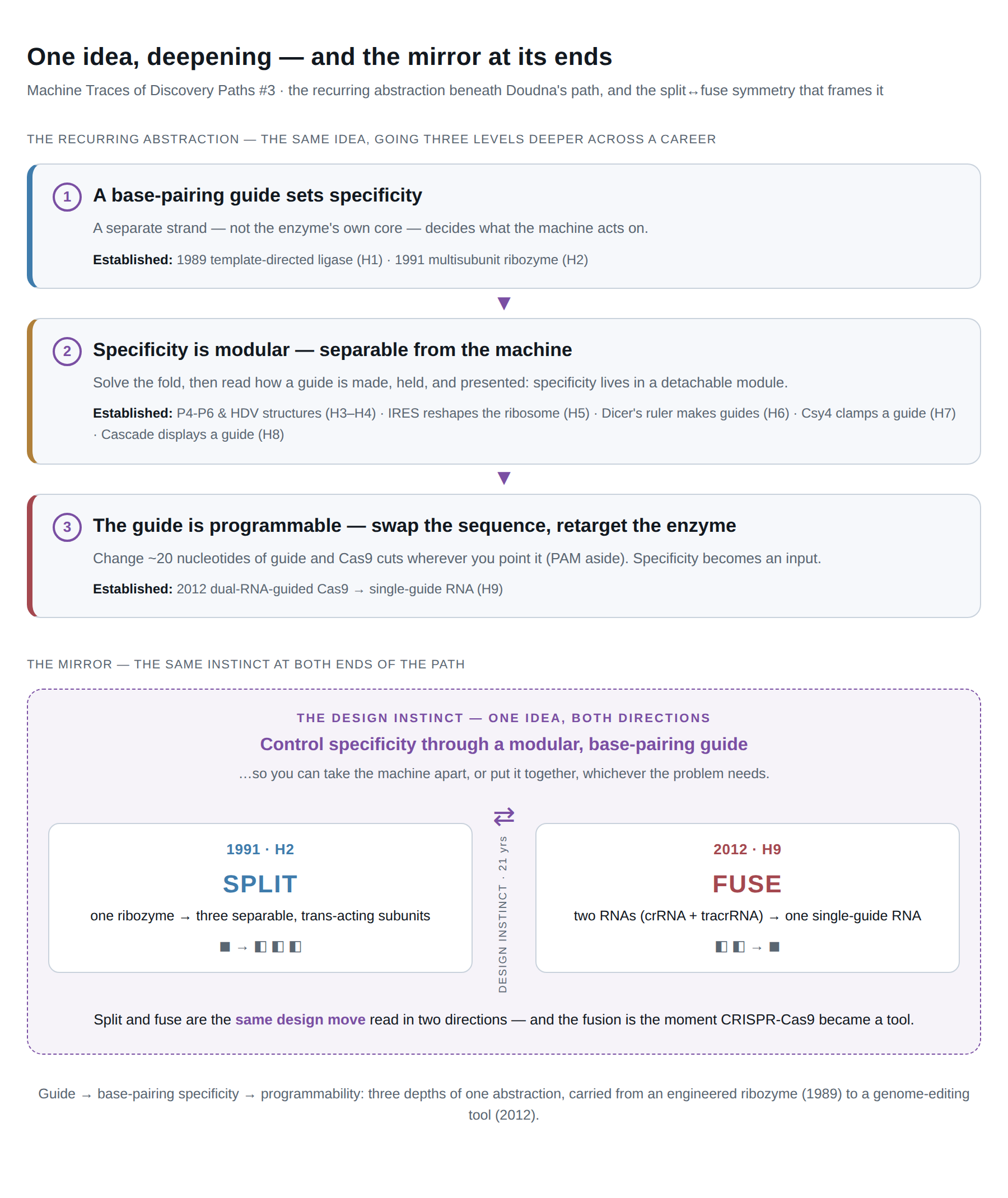
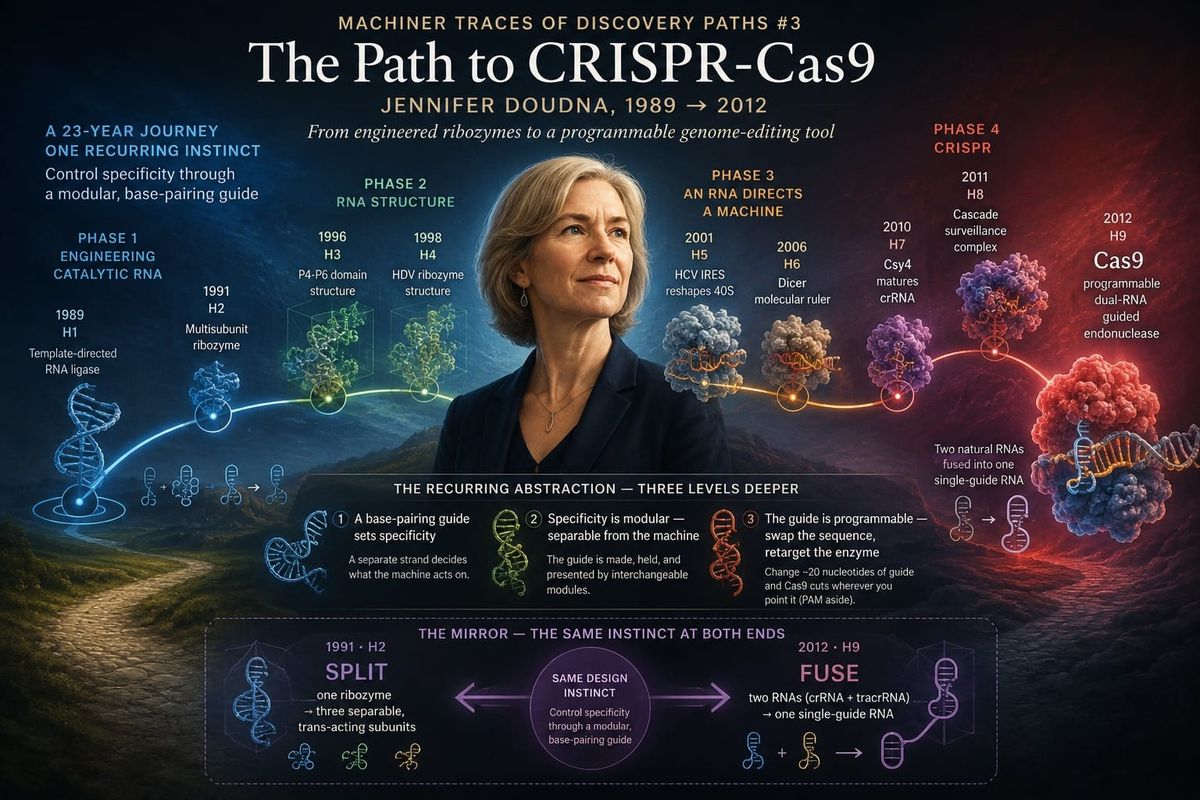
One idea deepening across Doudna's career — guide → base-pairing specificity → programmability — and the 1991-split / 2012-fuse mirror.
The thesis in one figure. A single abstraction goes three levels deeper across the career — a base-pairing guide sets specificity (1989–91), specificity becomes a separable module (the structure and RNAi years), and finally the guide becomes programmable (2012). Beneath it, the design instinct as a mirror: one ribozyme split into three subunits in 1991, two RNAs fused into one guide in 2012 — the same move read in two directions, and the fusion is the moment CRISPR-Cas9 became a tool.
Choosing the path
CRISPR-Cas9 has several parents, and a trace of "the discovery" in the abstract would have no single subject. Francisco Mojica named the loci and saw that their spacers matched invaders; Rodolphe Barrangou and Philippe Horvath showed the system was an adaptive immune system; John van der Oost's group (with Stan Brouns) showed that small CRISPR RNAs are the guides; Luciano Marraffini and Erik Sontheimer showed the target is DNA; Emmanuelle Charpentier found the tracrRNA; Virginijus Šikšnys demonstrated Cas9 cleavage in parallel. A path is a property of a person, so this reconstruction fixes its subject as Doudna and treats the others as influences — credited where the record shows they were used, but not nodes on her trajectory. That discipline matters: it is what keeps the account from collapsing into a generic history of a field and turns it instead into a trace of how one scientist's accumulated way of working arrived at a specific result. (The nine nodes are all papers Doudna authored; Brouns et al. 2008, often mis-remembered as hers, was checked and does not carry her name.)
Four phases, one habit
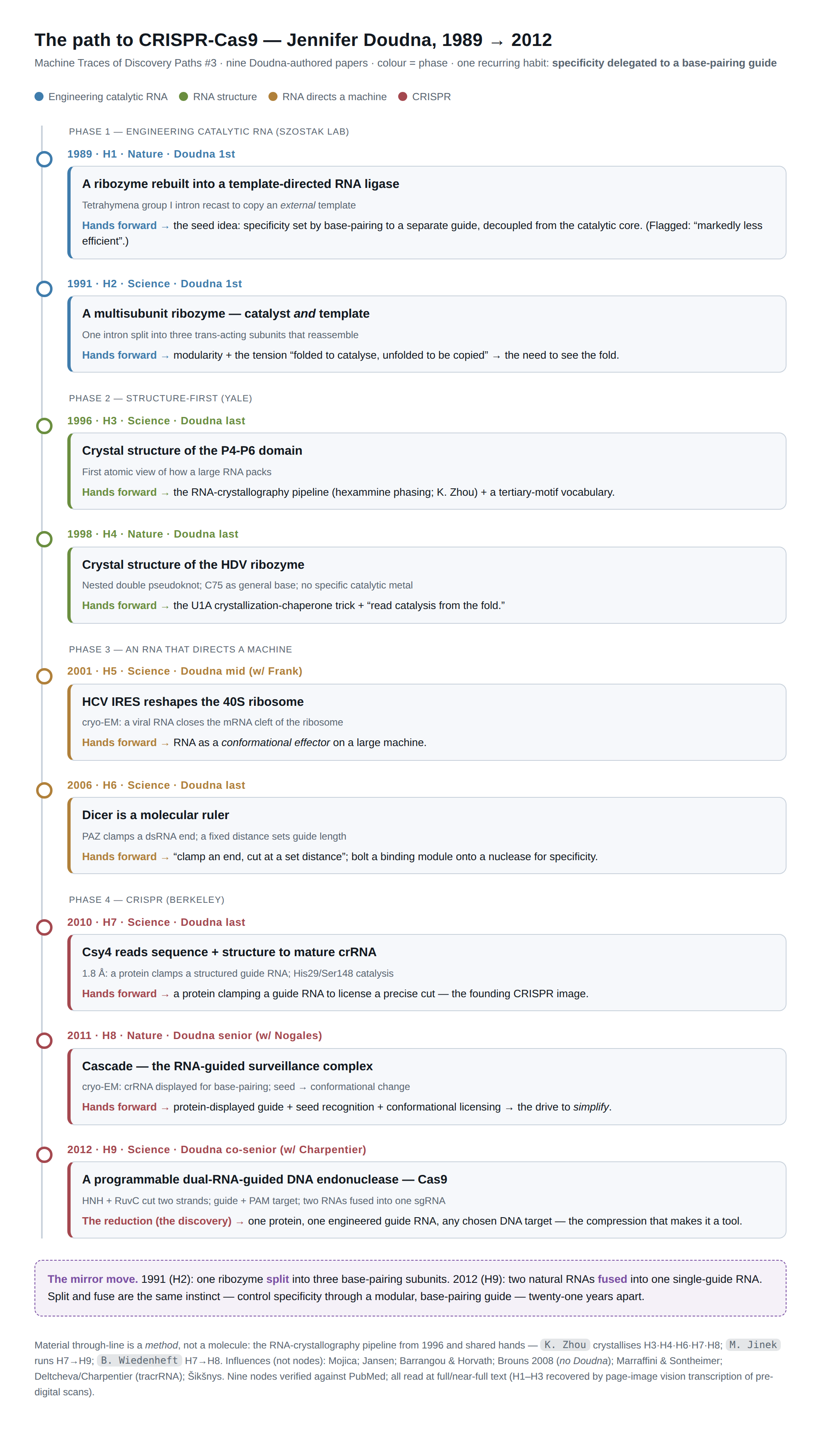
The path to CRISPR-Cas9 — Jennifer Doudna, 1989–2012: nine papers across four phases, with what each hands forward and the split/fuse mirror.
The path as a chain. Nine Doudna-authored papers in four phases, each annotated with what it handed forward. Colour = phase. The material through-line is a method and a set of hands — the RNA-crystallography pipeline from 1996 and shared personnel (Zhou across five structures; Jinek from Csy4 to Cas9) — not a physical reagent.
The nine papers fall into four phases, and reading them in order shows a single habit forming and then being applied to progressively larger machines.
The first phase is the engineering of catalytic RNA in Jack Szostak's laboratory. In 1989 Doudna took the Tetrahymena group I intron — an RNA already known to catalyse its own splicing — and rebuilt it into something new: a template-directed ligase whose product was set not by the intron's own internal guide sequence but by base-pairing to a separate, external template strand. The reaction was inefficient, and the paper says so plainly, but the idea underneath it is the seed of everything that follows: the specificity of an RNA catalyst can be delegated to Watson–Crick pairing with a guide, decoupled from the catalytic core. Two years later she pushed the same system further, cutting a self-splicing intron into three separate subunits that reassembled into an active complex that could copy one of its own pieces. The machine had been taken apart into modular, base-pairing components. That act of dissection — and the tension it exposed, that a ribozyme must be folded to work yet unfolded to be copied — is what drove the next phase.
The second phase answers that tension by looking. To understand how a catalytic RNA folds, Doudna's laboratory solved its structure — twice. The 1996 crystal structure of the P4-P6 domain of the Tetrahymena intron was the first atomic view of how a large RNA packs itself; the 1998 hepatitis delta virus ribozyme extended the same approach to a compact catalytic active site (and read its chemistry straight off the fold, placing C75 as the catalytic base). What matters for the path is less the two structures than what they left behind: a method — a way of phasing and crystallising discrete, independently folding RNAs, down to the trick of recruiting a small protein to coax an RNA into a crystal — and the people who ran it. Where the iPS path was carried forward by physical reagents, this one is carried by a pipeline and a set of hands: Kaihong Zhou crystallises across five of the nine papers, and the 1996 phasing strategy recurs for years. The through-line is a technique, not a molecule.
The third phase turns the structural method onto machines that an RNA directs. In 2001, working with Joachim Frank's cryo-electron microscopy group, the laboratory imaged the hepatitis C virus internal ribosome entry site bound to the small ribosomal subunit and caught the IRES doing something no RNA had been shown to do structurally: reshaping the ribosome, closing its messenger-RNA cleft, positioning the message without the usual protein factors. An RNA was no longer a passive scaffold but a conformational effector acting on a large protein machine. In 2006 the laboratory solved the structure of Dicer, the enzyme that generates the guide RNAs of RNA interference, and found that it works as a molecular ruler: a domain clamps one end of a double-stranded RNA, and a fixed physical distance to the cutting site sets the length of the guide it releases. "Measure from a clamped end, cut at a set distance" — and, more generally, "bolt a binding module onto a nonspecific nuclease to give it specificity" — is a mechanism the laboratory would meet again almost immediately, in bacteria.
The fourth phase is CRISPR, and by the time Doudna entered it she was carrying twenty years of exactly the right equipment. In 2010 her laboratory showed how Csy4 recognises and cuts a CRISPR transcript, clamping the structured repeat in a basic groove and threading an arginine-rich helix into its major groove to read both sequence and fold — a protein clamping a guide RNA to license a precise cut, the Dicer logic in a new setting. In 2011, with Eva Nogales's cryo-EM group, the laboratory solved the structure of Cascade, the multi-subunit surveillance complex, and saw the principle that would define the field: a protein scaffold holds a CRISPR RNA and presents it — protected from degradation yet available for base-pairing — so that an invading sequence is recognised beginning at a high-affinity "seed" and this recognition triggers a conformational change that licenses destruction. A protein-displayed guide RNA, reading a target by base-pairing, switching the machine on when it matches. Everything needed for Cas9 was now in hand except the simplification.
The turn that was not an anomaly
The iPS path bent at surprises: a cholesterol experiment that produced liver tumours, a knockout that unexpectedly could not differentiate. Reading Doudna's full corpus, the CRISPR turn is not of that kind. There is no experiment in her 2005–2008 record whose result forced her toward bacterial immunity; the redirect came from outside the publication record — a colleague's approach, a new problem carried in from another field. This is worth stating precisely, because it marks a limit of what a literature reconstruction can see. The corpus shows what a scientist did and when; it does not show why they chose a new direction when the reason lived in a conversation or a conviction rather than in a result. That motive belongs to Doudna's essays and lectures, and it is flagged here as outside the trace rather than invented to fill the gap. What the corpus does show is that once she turned, she brought a fully formed method to a problem that happened to be shaped exactly for it.
The reduction
The 2012 paper is, at its centre, an act of reduction — and it is the same act she had performed at the very beginning, run in reverse. The paper first establishes that Cas9 is guided: it cleaves target DNA only when supplied with both the crRNA that carries the twenty-nucleotide guide and Charpentier's tracrRNA; its two nuclease domains cut the two DNA strands, so that disabling either one turns the enzyme into a nickase; and the target must both match the guide and carry a short adjacent motif, the PAM. Then comes the move that made it a technology. The two natural RNAs were fused into a single chimeric guide RNA, and that one engineered molecule was sufficient to direct Cas9 to cut any chosen, PAM-flanked sequence. In 1991 Doudna had taken one ribozyme apart into separable, base-pairing subunits; in 2012 she and Charpentier fused two RNAs into one programmable guide. Splitting and fusing are the same instinct — control specificity through a modular, base-pairing guide — and the single-guide RNA is where a career of that instinct arrives.
General principles of a Machine Trace
Set beside the iPS reconstruction, this second path does more than add a case; it lets a few claims be stated as general principles of a Machine Trace, each now supported by two discoveries rather than one.
A handoff need not be material — a Machine Trace is a Transfer Trace. The iPS path was carried by physical reagents: each experiment's product became the next one's starting material. Doudna's path is carried by almost everything but a molecule — a crystallographic technique (the 1996 phasing pipeline, the U1A crystallisation chaperone), a set of people who moved between projects (Zhou across five structures; Jinek from Csy4 to Cas9), and above all a concept (the base-pairing guide). What a discovery path transmits from one step to the next can be a reagent, a technique, a person, or an idea; the trace records the transfer, whatever its medium. This is the most important generalisation the second path forces — and it means the object we are reconstructing is better called a Transfer Trace than a material lineage.
A path turns for one of two reasons — internal anomaly or external opportunity. The iPS path bent at surprises thrown up by its own experiments: the liver tumours, the differentiation block. Doudna's path shows no such internal anomaly at its decisive turn; it turned because a problem was carried in from outside — a bacterial immune system that happened to be shaped exactly for the method she already had. Anomaly-driven and opportunity-driven turns are two distinct engines of redirection, and a trace should identify which one it is looking at rather than forcing every turn into the shape of a surprise.
Compression often marks the moment of invention. In both discoveries the decisive step is a reduction. iPS narrowed twenty-four candidate factors to four; CRISPR-Cas9 reduced a two-domain protein guided by two RNAs to one protein guided by one engineered guide RNA. The instant a working system is stripped to its minimal, reprogrammable core is, in both cases, the instant it becomes a tool. Watching for the compression step is a way of locating invention inside a long path of accumulation.
These three — handoff-as-transfer, two kinds of turn, compression-as-invention — are not facts about biology; the second reconstruction suggests they are regularities of discovery paths themselves, and they are the beginning of a typology that further traces can fill in. A first sketch of that typology accompanies this piece as a Meta-Trace.
This is a first reconstruction of a second path, and it is honest about its seams: all nine papers were read at full or near-full text — the three earliest, which predate born-digital typesetting, were recovered by transcribing scanned page images rather than machine-extracted text; and the causal links, though supported by each paper's own statement of what it enabled, remain inference. What the path shows, even so, is a scientist who spent two decades learning how a structured guide RNA can direct a protein — and who, when a bacterial immune system put that exact problem in front of her, already knew how to read it, and how to make it small enough to program.
And it shows something past the single path. This second reconstruction does not merely add a case to a collection; it begins to expose regularities that recur across discovery paths — how work is handed forward, why a path turns, and where invention hides. Whether those regularities survive ten, twenty, or fifty reconstructions is now an empirical question rather than a philosophical one — which is the whole point of building the traces.
References
Cited in author–year form; full bibliographic detail in the accompanying Lab Notebook. Nine nodes verified against PubMed E-utilities (2026-08): Doudna & Szostak (1989); Doudna, Couture & Szostak (1991); Cate et al. (1996); Ferré-D'Amaré, Zhou & Doudna (1998); Spahn et al. (2001); Macrae et al. (2006); Haurwitz et al. (2010); Wiedenheft et al. (2011); Jinek et al. (2012). Influences (not nodes): Kruger et al. (1982); Jansen et al. (2002); Mojica et al. (2005); Barrangou et al. (2007); Brouns et al. (2008); Marraffini & Sontheimer (2008); Garneau et al. (2010); Deltcheva et al. (2011); Gasiūnas et al. (2012).
This is entry No. 3 of Machine Traces of Discovery Paths. The supporting Lab Notebook — the nine-paper mechanism-level reconstruction, the chain, the two-RNAs-to-one reduction, and the coverage record — is the verifiable source document behind this essay.
Lab notebook: https://thediscoveryengine.ai/machine-traces-of-discovery-paths-3-lab-notebook
Architectural Implications: https://www.thedscoveryengine.ai/the-discovery-trace-architectural-implications-from-crispr-cas9
How to cite
Kitano, H. (2026). The Path to CRISPR-Cas9 (Jennifer Doudna) — A Comprehensive Analysis and Reconstruction. The Discovery Engine — Machine Traces of Discovery Paths, No. 3.
Hiroaki Kitano ORCID: 0000-0002-3589-1953
Pubished: 16 Augst, 2026