Machine Traces of Discovery Paths #2 - The Path to iPS Discovery, A Comprehensive Analysis and Reconstruction
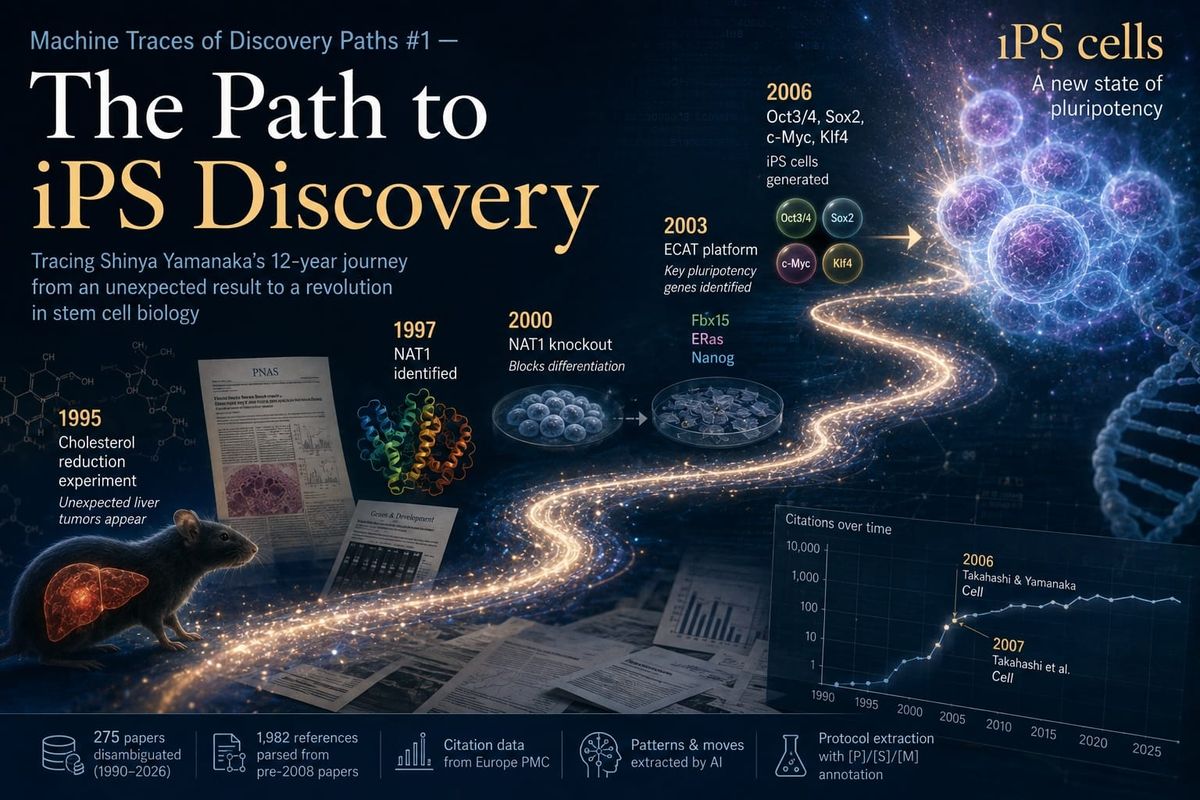
Machine Traces of Discovery Paths — Autonomous reconstructions of how landmark discoveries were reached, traced by AI from the primary literature.
Disclaimer — Discovery Trace Series. The Discovery Trace series is an experimental series of articles attempting the semi- or fully-automatic reconstruction of the paths to major discoveries. Multiple AI tools have been deployed to reconstruct each "Discovery Path." To evaluate the progress of the technology, an initial set of articles is published prior to rigorous verification, and may therefore contain errors and omissions. Content will be updated as corrections are made, with notes on publication history and a correction log.
This entry asks a methodological question: what changes when an AI system reconstructs a discovery from the full text of the papers, rather than from their abstracts?
The first entry in this series answered a different question — what was the path to induced pluripotent stem (iPS) cells — by reading the outside of the papers: Machine Traces of Discovery Paths #1 assembled the corpus from abstracts and reference lists and recovered four hinge points. This entry reads the inside. The full text — Methods and Results — of the nine skeleton papers was given to the system, and the path was reconstructed from what the experiments actually did. The result is not merely a more detailed version of #1. In places it corrects it, and it makes visible two features of the discovery — a chain of physical reagents, and a layer of tacit knowledge the papers omit — that the abstract-level trace could not see at all.
There is a reason the two depths differ so much. An abstract is a tidy story: the authors' retrospective account, with the dead ends pruned and the logic straightened. The Methods section is the raw record — what was actually mixed, selected, counted, and discarded. Reading the raw record is what surfaces the messier and truer shape of the work, including two places where the standard account of how the four factors were found turns out to be wrong.
What was done
The system was given the full text of nine papers spanning 1994–2006 — the skeleton of the path from Yamanaka's cloning of the apoB mRNA-editing enzyme to the four-factor induction of pluripotency. It read each paper's Methods and Results, reconstructed each experiment as "what was done, what came out, what it made possible next," and extracted every protocol value the paper printed. Abstracts were not used.
The reconstruction is bounded by the primary text and checked against it. Seventy experiments were reconstructed — roughly eight per paper — and every one carries a verbatim quotation from the source, all confirmed against the original (word-match 1.00). Of 818 numeric tokens in the extracted protocols, none disagreed with the printed source; one was flagged as a probable typographic error in the original and tagged accordingly. The 24-factor list was verified against the 2006 paper's body and Supplemental Data.
The chain, read in full
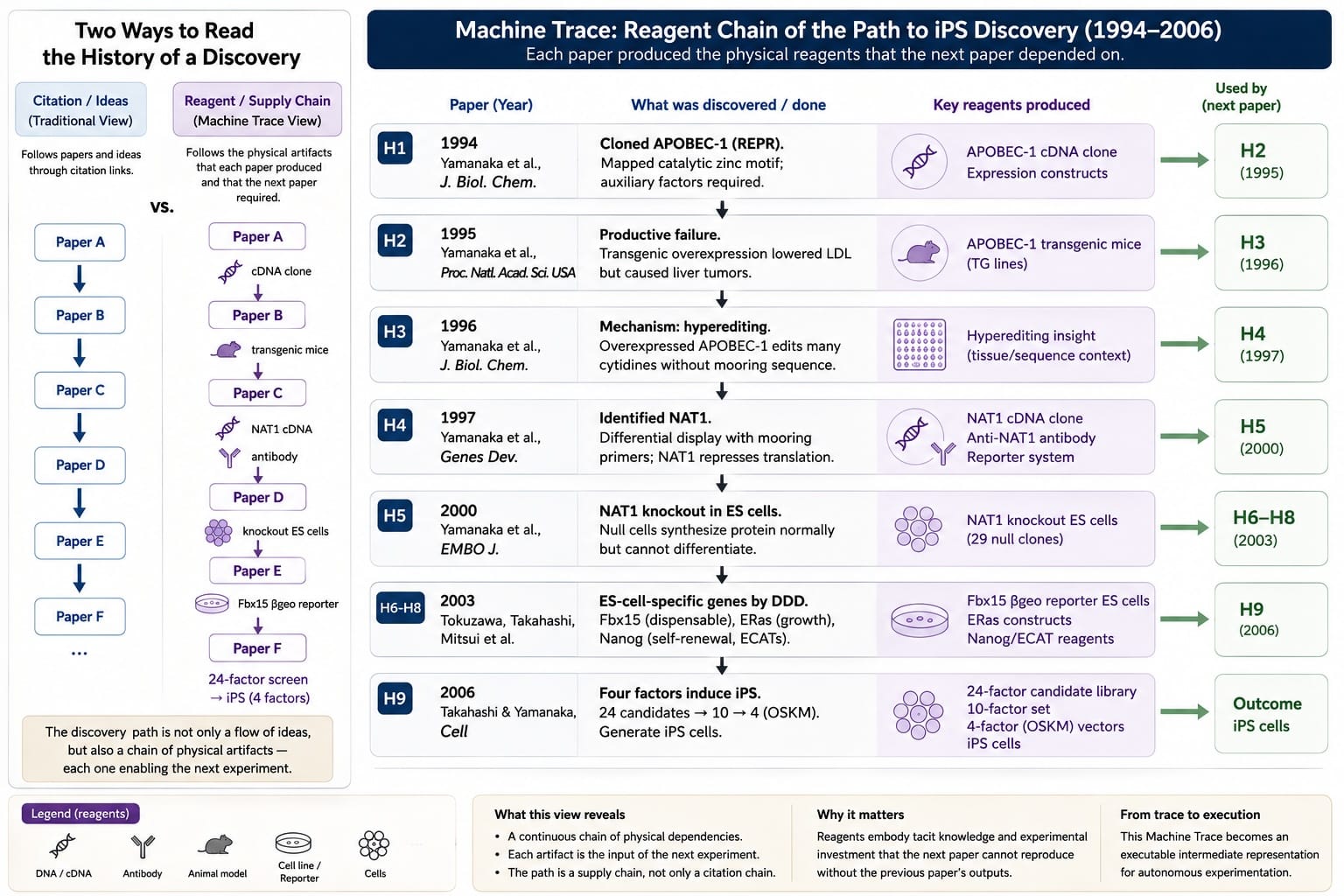
The nine papers form a continuous chain. Read at the level of abstracts, it is a sequence of four conceptual pivots. Read at the level of Methods, it is a sequence of nine experiments, each of which produced a physical reagent — a clone, an antibody, a cell line — that the next experiment required.
H1 — 1994, cloning APOBEC-1. The rabbit apoB mRNA-editing enzyme (REPR/APOBEC-1) was cloned and its catalytic zinc motif mapped by site-directed mutagenesis; the editing activity required auxiliary factors present in tissues that do not edit apoB (Yamanaka, S. et al., 1994). This produced the cDNA clone and expression constructs the next paper needed.
H2 — 1995, the productive failure. Transgenic animals overexpressing APOBEC-1 in liver were built to lower LDL cholesterol. They did — and every line developed liver dysplasia and hepatocellular carcinoma, one liver reaching 40% of body weight (Yamanaka, S. et al., 1995). The paper treated this not as a failed lipid experiment but as a cancer question, and identified a second edited transcript, implying there were more.
H3 — 1996, the mechanism. The tumours were traced to hyperediting: overexpressed APOBEC-1 edits many cytidines beyond the canonical site, and does so without the mooring sequence that normal editing requires (Yamanaka, S. et al., 1996). This established that other transcripts were being mis-edited — so the question became which one matters.
H4 — 1997, NAT1. A modified differential display, using mooring-sequence primers, found the transcript: NAT1, an eIF4G-homologous protein that binds eIF4A but not eIF4E and represses both cap-dependent and cap-independent translation (Yamanaka, S. et al., 1997). This gave Yamanaka a gene of his own — the currency for an independent laboratory — plus its cDNA, an antibody, and a reporter system.
H5 — 2000, the knockout. The NAT1 knockout was built to test its predicted role as a global translation repressor. That prediction failed: null ES cells synthesized protein normally. What they could not do was differentiate — 29 of 64 selected clones were null, and all 29 behaved abnormally off feeders; null teratomas contained no striated muscle or cartilage in any of fourteen tumours (Yamanaka, S. et al., 2000). To build this knockout, Yamanaka had to learn ES-cell culture. The differentiation phenotype was a by-product of a routine genotyping step, not the hypothesis under test.
H6, H7, H8 — 2003, the platform. Three papers, all using the same method — identify genes expressed specifically in ES cells by digital differential display, then test them one at a time. Fbx15, an Oct3/4–Sox2 target with an 18-bp composite enhancer, proved dispensable: knockouts were normal and fertile (Tokuzawa, Y. et al., 2003). ERas, an ES-specific constitutively active Ras, signalled through PI(3)K rather than Raf/MAPK and drove ES-cell growth and tumorigenicity (Takahashi, K. et al., 2003). Nanog, found in the same screen as ecat4, maintained self-renewal without LIF and anchored a catalogue of ES-cell-associated transcripts, the ECAT series (Mitsui, K. et al., 2003).
H9 — 2006, the four factors. Twenty-four ECAT candidates were introduced into fibroblasts carrying a selectable marker at the Fbx15 locus; the pool was narrowed to four — Oct3/4, Sox2, c-Myc, Klf4 — sufficient to reprogram both embryonic and adult fibroblasts to pluripotency (Takahashi, K. & Yamanaka, S., 2006).
What reading the full text revealed
Four things are visible in the Methods that the abstracts do not contain. Two of them revise the standard account of how the four factors were found.
The four factors were not found in one step. The abstract-level account — including the first entry in this series — says the 24 candidates were narrowed to four by leave-one-out. The Methods show two rounds of removal. Removing any of ten factors from the pool of 24 abolished colony formation; the remaining fourteen were dispensable. That ten-factor pool then produced more ES-like colonies than all 24 together — the full set contained factors that were actively inhibitory. Only a second leave-one-out, applied to the ten, separated the four. The intermediate ten-factor stage does not appear in the abstract, and it changes the shape of the selection: the screen did not filter 24 down to 4, it filtered 24 to 10 to 4, discarding inhibitors along the way.
The selection reporter was not measuring pluripotency. The Fbx15 locus, carrying the selectable marker, could be activated by only three of the four factors: Oct3/4 + Klf4 + c-Myc, without Sox2, produced 54 colonies, six of them serially passageable — but with a coarser morphology than genuine four-factor iPS cells. The reporter reported activation of the Fbx15 locus, which is not the same thing as acquisition of pluripotency. The abstract-level account can say only that Fbx15 was dispensable and therefore usable as a marker. The full text shows the deeper point: the marker and the state it was standing in for had come apart, and it was precisely this gap that made the move to Nanog-based selection, the following year, necessary rather than merely an improvement.
The chain is a chain of reagents, not only of ideas. Read as concepts, the path is a sequence of insights. Read as Methods, it is a sequence of physical objects handed forward. The 1994 expression construct built the 1995 transgenic animals. The 1997 NAT1 cDNA and antibody made the 2000 knockout analysis possible. And the Fbx15-βgeo knock-in cell line built in the 2003 Fbx15 work is the screening system of 2006 — the reporter cells into which the 24 factors were introduced. Each paper's Methods section names, as its starting material, a reagent produced by an earlier paper in the chain. The path did not merely accumulate knowledge; it accumulated tools, and each tool was the precondition for the next experiment. A history of science written from abstracts records a citation graph — who influenced whom. Written from Methods, it records something else as well: a supply chain, in which each experiment consumes the physical product of the last.
The published papers do not contain executable protocols — and this is universal across the chain. The first entry found this for one paper: the 2000 knockout never states the composition of its ES-cell medium. Reading all nine confirms it is not an exception but the rule. Across the nine papers, the full composition of the ES-cell culture medium — base medium, serum, supplements — is stated not once, including in the paper with the most detailed Methods, where it appears only as "ES cell medium." In total, 104 items required to run these experiments — media compositions, seeding densities, scoring rubrics, statistical methods, electroporation settings — are absent from the papers and must be supplied from period-standard practice to make the protocols runnable. Against 444 extracted parameters, that is roughly one missing item for every four the papers state: the gap is not a handful of oversights but a structural feature of the record.
What is already automatable, and what is not
If a reconstruction like this is to feed the second stage of discovery — automated experimentation — the natural question is how much of this particular path a machine can already run. The answer is that the path is not uniform: its experiments sit at very different levels of automation, and the hardest parts coincide with exactly what the full-text trace made visible.
The molecular-biology experiments that dominate the early chain (H1–H4) — PCR, cloning, sequencing, blotting, in-vitro editing assays — are routinely automated today on liquid-handling robots. The cell-culture and differentiation work of the later chain (H5–H9) has reached further than that: an autonomous robot–AI system (Maholo LabDroid) searched 200 million parameter combinations to optimise the differentiation of iPS-derived retinal pigment epithelial cells, running 143 conditions over 111 days with no human intervention and reaching 88% higher pigmentation than the pre-optimised protocol (Kanda, G. N. et al., 2022) — the same iPS lineage that terminates this path, optimised by machine. Notably, that system began by turning the culture protocol into a digital representation the robot could execute — the same intermediate object this series is arguing must be reconstructed from the literature.
The embryo work (the blastocyst injection and germline transmission in H5 and H8) is only partly automated: machine-vision-guided injection robots are raising throughput, but cell finding, immobilisation, and orientation still involve a human operator. Phenotype scoring — teratoma histology, colony morphology — is increasingly assisted by deep-learning image analysis, but the final judgement remains supervised. And the tacit layer — the 104 absent items — is not a matter of automation at all: there is nothing in the paper to execute, so the values must be generated before any robot can run the step.
Around these specific experiments, the broader infrastructure for automated experimentation is maturing quickly. Emerald Cloud Lab, and the CMU Cloud Lab built on it, operate close to 200 instruments remotely (2024). Coscientist demonstrated a large-language-model agent designing, planning, and executing chemistry experiments and running them on a cloud lab (Boiko, D. A. et al., 2023). In multi-omics, the MANTA platform (OIST and CSB) automates metagenomic and microbiome analysis — the most advanced automation in that domain, though cell systems such as iPS are not yet in its scope. What these platforms share is that they execute a protocol a human designed, or search a parameter space a human defined. The layer still missing sits upstream of all of them: reconstructing the discovery path itself — the experiments, the reagents that connect them, and the tacit values they omit — into a form an execution platform can take as input. That layer is what this trace occupies.
The two frontiers, from the inside
The first entry named two frontiers that this kind of trace does not cross. Reading the full text sharpens the second one.
On the discovery side, the forward generation of a redirecting framing — the subject of Can a Machine Connect Distant Dots? (Post #4) — remains untouched here; this is a retrospective reconstruction of a known path.
On the execution side, the picture is now concrete. Automating the second stage of discovery requires two things the full text makes measurable. First, the tacit layer: the 104 absent items are not incidental omissions but the knowledge expert practitioners carry and papers assume, and an automated system must generate it rather than retrieve it. Second, the reagent chain: because each experiment consumes a physical product of the last, executing a discovery path is not running nine independent protocols but running them in an order where each produces the input to the next. The reconstruction is not, in the end, the destination. It is the executable intermediate representation that autonomous experimentation requires as its input — and this trace is one complete instance of it, for one discovery, with the tacit layer and the reagent order made explicit rather than assumed.
Resolution: abstract versus full text
The two reconstructions of the same discovery differ as follows.
| #1 — abstract + references | #2 — full text | |
|---|---|---|
| Source text read | none (abstracts, reference lists) | 9 papers (Methods/Results, plus Supplemental Data) |
| Hinge points | 4 | 9 |
| Experiments reconstructed | 0 | 70 |
| Verbatim-quote support | 0 | 70 (all confirmed against source) |
| Protocol parameters extracted | 0 | 444 |
| Missing items made explicit | 0 | 104 |
| The 24 factors | "24 candidates" (count only) | all 24 named, in Supplemental order |
| Factor selection | "narrowed to 4 by leave-one-out" | 24 → 10 → 4, with colony counts at each stage |
| Role of the 2003 papers | abstract-level (Fbx15 dispensable, etc.) | full-text (βgeo knock-in reused, PI(3)K binding, ECAT catalogue) |
The comparison is the point of running the trace at two depths. The same procedure, given the outside of the papers, recovers a correct but coarse skeleton; given the inside, it recovers the experiments, the reagents that connect them, and the exact places where the published record stops short of what the work required. Input depth determines the resolution of the reconstruction — which is the subject the next entry in this series takes up directly.
Data and evidence
The reconstruction is based on the full text of nine papers (1994–2006). For each, the trace records every experiment with its verbatim support, every protocol parameter the paper prints, and every item it omits; it also records, for each transition, the specific reagent the earlier paper handed to the later one, with citations on both sides. The complete per-paper reconstruction — the seventy experiments, the 444 protocol parameters under [P] tags, the 104 gaps under [S] tags, and the reagent-by-reagent connection analysis — is published as the Evidence documents for this entry in the Lab Notebook (https://thediscoveryengine.ai/machine-traces-of-discovery-paths-2-lab-notebook/).
This entry was produced with AI. The full-text reconstruction and protocol extraction were performed by Claude Science working autonomously from the source papers, with every experiment supported by a verbatim quotation confirmed against the original and every numeric value checked against the printed text; this write-up was drafted from that work with Claude. The record shows what was done and can be checked against the underlying papers.
Hiroaki Kitano
References
Cited in author–year form; listed alphabetically by first author, then year. Bibliographic fields retrieved from PubMed E-utilities and reconciled against the source papers.
(Boiko, D. A. et al., 2023) Boiko DA, MacKnight R, Kline B, Gomes G. Autonomous chemical research with large language models. Nature. 2023;624(7992):570-578. doi:10.1038/s41586-023-06792-0. PMID: 38123806.
(Kanda, G. N. et al., 2022) Kanda GN, Tsuzuki T, Terada M, Sakai N, Motozawa N, Masuda T, et al. Robotic search for optimal cell culture in regenerative medicine. eLife. 2022;11:e77007. doi:10.7554/eLife.77007. PMID: 35762203.
(Mitsui, K. et al., 2003) Mitsui K, Tokuzawa Y, Itoh H, Segawa K, Murakami M, Takahashi K, et al. The homeoprotein Nanog is required for maintenance of pluripotency in mouse epiblast and ES cells. Cell. 2003;113(5):631-42. doi:10.1016/s0092-8674(03)00393-3. PMID: 12787504.
(Takahashi, K. et al., 2003) Takahashi K, Mitsui K, Yamanaka S. Role of ERas in promoting tumour-like properties in mouse embryonic stem cells. Nature. 2003;423(6939):541-5. doi:10.1038/nature01646. PMID: 12774123.
(Takahashi, K. & Yamanaka, S., 2006) Takahashi K, Yamanaka S. Induction of pluripotent stem cells from mouse embryonic and adult fibroblast cultures by defined factors. Cell. 2006;126(4):663-76. doi:10.1016/j.cell.2006.07.024. PMID: 16904174.
(Tokuzawa, Y. et al., 2003) Tokuzawa Y, Kaiho E, Maruyama M, Takahashi K, Mitsui K, Maeda M, et al. Fbx15 is a novel target of Oct3/4 but is dispensable for embryonic stem cell self-renewal and mouse development. Mol Cell Biol. 2003;23(8):2699-708. doi:10.1128/MCB.23.8.2699-2708.2003. PMID: 12665572.
(Yamanaka, S. et al., 1994) Yamanaka S, Poksay KS, Balestra ME, Zeng GQ, Innerarity TL. Cloning and mutagenesis of the rabbit ApoB mRNA editing protein. A zinc motif is essential for catalytic activity, and noncatalytic auxiliary factor(s) of the editing complex are widely distributed. J Biol Chem. 1994;269(34):21725-34. doi:10.1016/s0021-9258(17)31865-3. PMID: 8063816.
(Yamanaka, S. et al., 1995) Yamanaka S, Balestra ME, Ferrell LD, Fan J, Arnold KS, Taylor S, et al. Apolipoprotein B mRNA-editing protein induces hepatocellular carcinoma and dysplasia in transgenic animals. Proc Natl Acad Sci U S A. 1995;92(18):8483-7. doi:10.1073/pnas.92.18.8483. PMID: 7667315.
(Yamanaka, S. et al., 1996) Yamanaka S, Poksay KS, Driscoll DM, Innerarity TL. Hyperediting of multiple cytidines of apolipoprotein B mRNA by APOBEC-1 requires auxiliary protein(s) but not a mooring sequence motif. J Biol Chem. 1996;271(19):11506-10. doi:10.1074/jbc.271.19.11506. PMID: 8626710.
(Yamanaka, S. et al., 1997) Yamanaka S, Poksay KS, Arnold KS, Innerarity TL. A novel translational repressor mRNA is edited extensively in livers containing tumors caused by the transgene expression of the apoB mRNA-editing enzyme. Genes Dev. 1997;11(3):321-33. doi:10.1101/gad.11.3.321. PMID: 9030685.
(Yamanaka, S. et al., 2000) Yamanaka S, Zhang XY, Maeda M, Miura K, Wang S, Farese RV Jr, et al. Essential role of NAT1/p97/DAP5 in embryonic differentiation and the retinoic acid pathway. EMBO J. 2000;19(20):5533-41. doi:10.1093/emboj/19.20.5533. PMID: 11032820.
How to cite
Kitano, H. (2026). Machine Traces of Discovery Paths #1 - The Path to iPS Discovery, A Comprehensive Analysis and Reconstruction, The Discovery Engine
ORCID: 0000-0002-3589-1953
https://orcid.org/0000-0002-3589-1953
First published: August 14, 2026