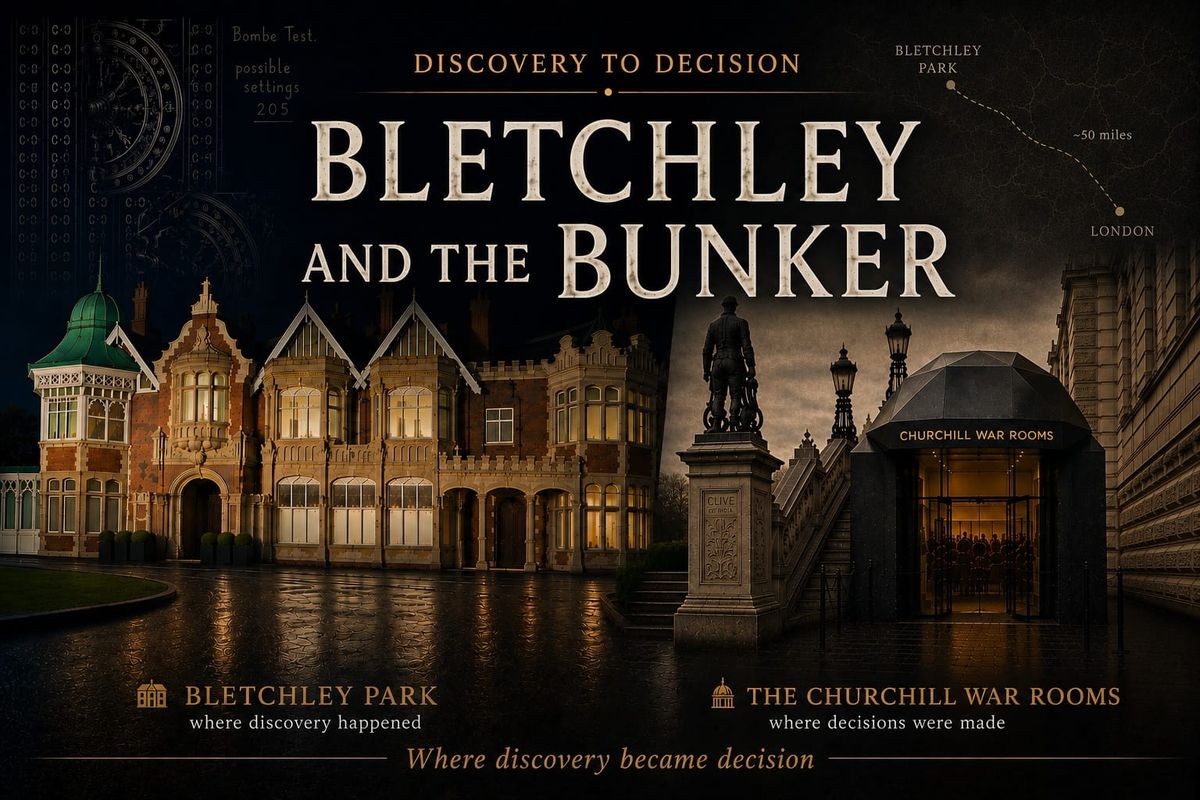
Bletchley and the Bunker
Discovery Engine — Discovery to Decision · Part 1
Hiroaki Kitano
Where discovery became decision.
Two rooms, fifty miles apart
At the end of February 2020 I was in London, chairing a workshop about whether a machine could discover.
The three of us who convened it — Yolanda Gil, Ross King, and myself — had brought thirty people from three continents into a room for two days to ask a single question: could an artificial system make discoveries good enough to stand beside the best human science, on its own, and could we set that as a goal to aim at? We called it the Nobel Turing Challenge. The name was deliberate. Turing's 1950 test asked whether a machine could hold a conversation you could not tell from a human's; we were asking whether a machine could do science you could not tell from the best human's (Alan Turing Institute, 2020). That question is the reason this blog exists.
On the afternoon of the 28th, before catching the evening flight home — ANA's NH212, Heathrow to Haneda — I went, in the rain, down a set of stairs off King Charles Street into the Churchill War Rooms. I went because I had watched The Imitation Game and Darkest Hour, and wanted to stand in the place the second film was about.
The War Rooms are a bunker. From 1939 they were the underground rooms from which Britain ran the war: a Cabinet Room, a Map Room manned day and night, a warren of cramped offices under a government building in Whitehall. This is where decisions were made. In the Map Room, officers pulled together the day's information from around the world into a summary that went each morning to the Prime Minister, to the Chiefs of Staff, and to the King (IWM, n.d.). Standing there, I was at the far end of something. Because a great deal of what was decided in that bunker rested on intelligence that had been discovered somewhere else — fifty miles to the north, at Bletchley Park, where the codebreakers who found it never set a single policy.
Two rooms, then. In one, people discovered. In the other, people decided. Between them lay fifty miles, a chain of hands, and everything this series is about.
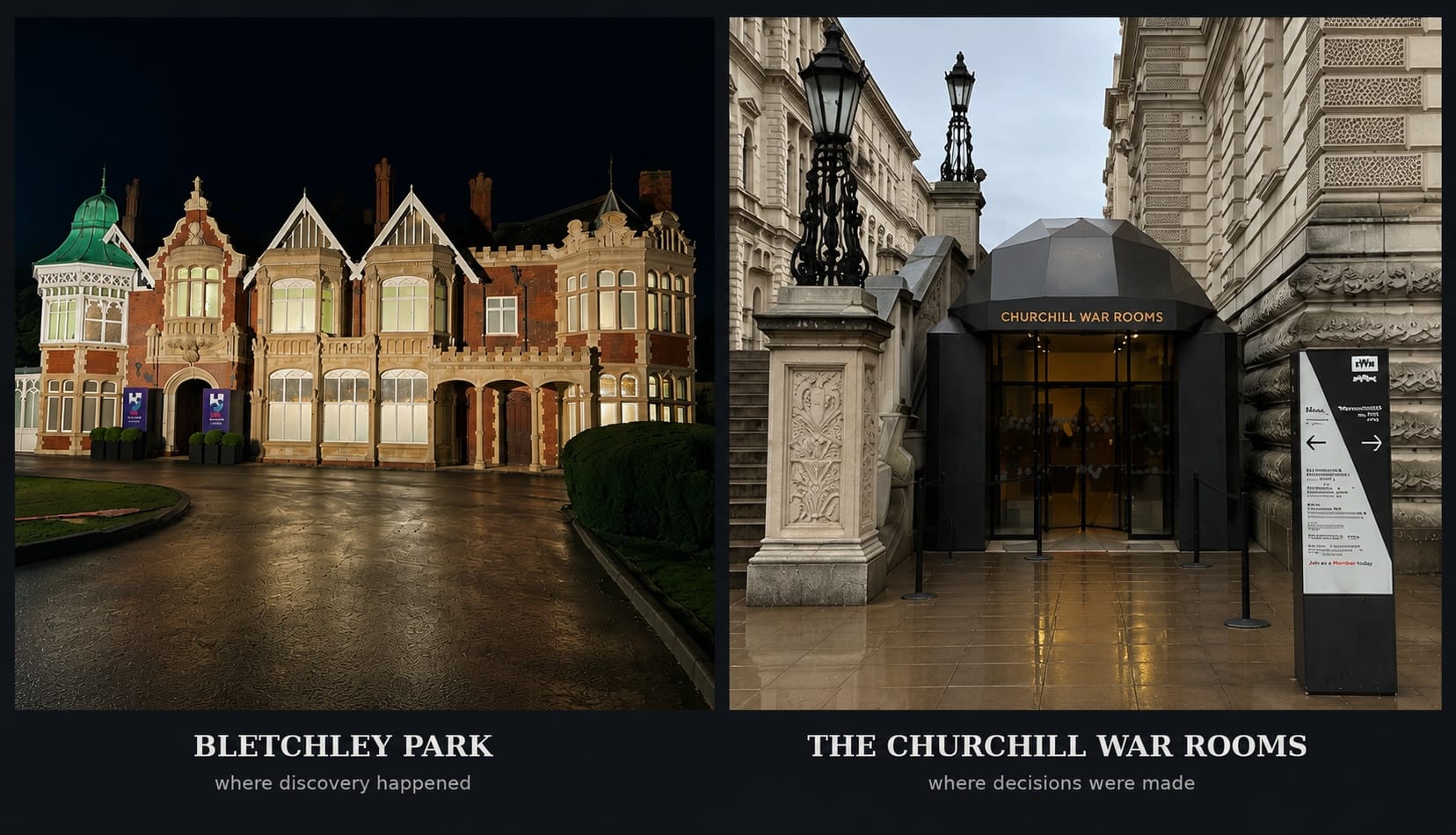
Discovery and decision, fifty miles apart. Left: Bletchley Park, where the codebreakers worked. Right: the entrance to the Churchill War Rooms in Whitehall, where the war was run. Both photographed by the author.
I did not yet know that within a few weeks I would find myself somewhere on that same line, in a different emergency — not at the deciding end, as it turned out, but on the side that gathers the findings and hands the choices across, the side Bletchley's Hut 3 would have recognised. That is a story for a much later part of this series; I only flag it here. For now, the two rooms are enough to begin with.
The gap
We talk about discovery as if it were the hard part and the end of the story. Find the thing — break the cipher, run the model, see the result — and the rest is detail. It is not. Discovery produces a finding: a decrypted message, a piece of intelligence, a result. A decision is an act: someone has to do something about it, or decline to, and live with the consequence. Between the finding and the act lies work that is neither — integrating fragments into a picture, translating that picture into terms a decision-maker can use, handling what remains uncertain, protecting the finding from exposure, and judging the two hardest questions of all: when to act, and how much.
That in-between is the subject of this series. It is easy to overlook, because we give the discovery the credit and the glory, and treat what follows as mere administration. But the history says otherwise: a sound finding, badly carried across that gap, changes nothing; and the width of the gap — not the brilliance of the finding — is often what decides whether the discovery mattered at all. Bletchley is the clearest case I know of, because there the finding was as good as findings get, and the distance it still had to travel to become a decision was enormous, and deliberate.
The Alan Turing Series on this blog spent two parts on the discovery end of that story — on Turing's machines, and the Bombe that searched a space no human could cross. But the Bombe only searched. What its output meant, and what anyone should do about it, was decided by other people, in other buildings, later. This series is about those other people and those other buildings. The Turing series asked whether a machine can discover; this one asks what happens next — how a discovery becomes a decision.
It rests on two facts, and the two rooms already contain both.
The first: discovery and decision are different processes. They are separated by time, by translation, by uncertainty, and by secrecy.
The second: discovery and decision are usually carried by different people. They are separated by authority, by trust, by interest, and by responsibility. The fifty miles between Bletchley and the bunker is the first picture of that separation.
Different processes
Take the first of those two facts — that discovery and decision are different processes — and follow one decrypt through Bletchley to see it. Four things stood between the broken message and any action taken on it, and none of them was the codebreaking.
It begins against a clock — though not the clock you might expect. The German keys changed at midnight, so the breaking was the part bound to the day: a setting not recovered before it changed was gone, and the codebreakers started again from nothing. But once a message was broken, what it told you did not expire at midnight. A decrypt might reveal where a U-boat pack was gathering, or how a division was being moved — intelligence a commander could act on tomorrow, or next week, or fold into a plan not yet made. Discovery here ran on a brutal daily deadline; the decisions it fed ran on their own, slower and more varied clocks. That mismatch of tempo is the first sign that the finding and the act are genuinely different processes, and not one continuous rush from cipher to command.
Then came translation — and a broken message still needed a great deal of it. A raw decrypt is rarely usable as it stands: a fragment, full of map references and unit codes, in German military jargon the reader has to know. Someone had to work out what it actually said, and what it meant in the wider picture. At Bletchley an entire section, Hut 3, did nothing else. It took the fragments, set them against everything already known about the enemy, and produced intelligence: situation reports, and short "headlines" that told a busy staff which of the last day's messages actually mattered. The most important were distilled into the buff-coloured box that reached Churchill every morning (Kenyon, 2019). Only after Hut 3 had rewritten, ranked, and framed it was the finding something anyone could decide on. Breaking the cipher made the intelligence possible; Hut 3 made it usable.
And even once a message was read, certainty did not arrive with it. Before that — in the breaking itself — the codebreakers lived in probabilities: which wheel setting was likeliest, given the day's evidence, was a matter of degree, and Turing built part of the machinery for weighing it. Banburismus was his hand method for judging how strongly the evidence favoured one guess over another, in units he named the ban and the deciban (Good, 1979). But the deeper uncertainty outlived the decode. A decrypt could be read perfectly and still leave the real questions open: was this the enemy's true intention or a feint, the main thrust or a diversion, a plan he would keep or abandon? The finding came with degrees of confidence attached; the decision could not. Sail the convoy or hold it — and if you sail it, by which route — is a single choice, made once. The uncertainty could not be passed along with it. Someone had to act as if one reading were true, knowing it might not be, and own the result either way.
The hardest step of all was that using the finding could destroy it. If the Germans ever suspected Enigma was being read, they would change it and the whole apparatus would go dark overnight. So the more valuable a decrypt was, the more dangerous it was to act on. Commanders who wanted to strike at a convoy that Ultra had located sometimes had to arrange first for a reconnaissance aircraft to be seen "finding" it, so the enemy would blame the aircraft and not the cipher (Hinsley, 1993). The decision had to be laundered of its origin before it could be taken. Discovery and decision were tied so tightly together that the act had to be disguised in order to protect the discovery.
Look back at what that one decrypt had to survive on its way to becoming an order. A deadline, though only the breaking was bound by it. A translation, before the message meant anything to a commander. A residue of doubt that no decode could remove. And a secret so valuable that acting on it risked destroying it. Four obstacles — and not one of them is a problem with the codebreaking itself. The message was broken cleanly; the discovery was sound. Everything that made it hard to use lay after the finding and before the act — in the space between the two, which is the real subject of this series.
Different actors
The second fact matters more, I think, than the first — and the two rooms illustrate it almost perfectly, precisely because they are two rooms and not one.
I owe the point to a conversation on the gravel outside the Mansion at Bletchley Park, with the Trust's historians, on a later visit. Breaking the ciphers, David Kenyon, its research historian, pointed out, was only the start. Most of the people at Bletchley were not codebreakers at all. They were the thousands who took the decrypts and turned them into intelligence a commander could act on — an operation Kenyon calls, aptly, an intelligence factory (Kenyon, 2019). The codebreaking is the famous part. The factory around it — the part that actually reached a decision — is the larger and less told story, and it is the one this series is about.
The person who discovers is rarely the person who decides. The codebreaker was not the admiral. Bletchley was not the bunker. And the gap between them was not an accident — it was designed that way.
Bletchley turned the separation into an assembly line. Hut 6 and Hut 8 broke the ciphers. Hut 3 fused and translated what they broke. From there the intelligence went two ways: out to the field commands, carried by Special Liaison Units — a distribution system built expressly to get Ultra to a general without revealing where it came from — and up to the centre in London, where the day's most important material reached Churchill and the Chiefs of Staff in the Whitehall bunker. Either way, the intelligence side stopped, deliberately, short of command: it delivered knowledge, and someone else gave the order. Hut 3 had become an intelligence agency in its own right, producing knowledge of great value but never itself acting on it (Kenyon, 2019).
And the distance from finding to decision was not the same for everyone — the British varied it on purpose. Naval Ultra was handled differently from the army's and the air force's, because the customer was different. Decrypts about U-boats went to the Admiralty's Operational Intelligence Centre and almost nowhere else, because the Admiralty was an operational headquarters that could give orders in the middle of a battle — the finding could become an act in one short step (Wikipedia, n.d.). Army and air intelligence, by contrast, fed directives that theatre commanders then carried out with wide discretion, the act sitting far downstream of the finding. Same intelligence, different distance to the decision — chosen deliberately, case by case.
And the same separation was visible even inside the bunker, in a single room. In the War Rooms' Map Room, officers from the army, the navy, and the air force, with a civil servant among them, collated the incoming picture. The five senior men who ran it were nicknamed the Glamour Boys — the work was so secret it seemed, to outsiders, mysterious and glamorous (IWM, n.d.). What they collated, the Joint Planners and the Joint Intelligence Staff turned into strategic options; from those options, the Chiefs of Staff chose. Collation, options, decision — three jobs, three sets of people, in one underground room. The fifty-mile separation between Bletchley and Whitehall reappeared in miniature at the end of the line.
Why does the separation matter so much? Because splitting the finding from the act puts strain on the join between them, in four places — over who has the power, whether the finder is believed, whose interests come first, and who is to blame if it goes wrong.
There is authority. The decider can overrule the finding, and is entitled to. The one who discovered has no command, and must live with being overruled by someone who knows less about the finding and more about everything else.
There is trust. The decider has to act on a process they cannot see inside. This is why the credibility of Hut 3 was itself a weapon: a commander who did not trust the source would hesitate, and hesitation in the window was as good as having no intelligence at all.
There is interest. The one who discovered guards the finding's fragility — protect the source, keep the caveats attached, do not overclaim. The one who decides wants a clear answer now, without the hedges. The two want opposite things from the same report, and that pull is exactly how a careful finding ends up heard as a firm promise, or a firm finding dismissed as hedging.
And there is responsibility. When it goes wrong, the discoverer offered "intelligence" and the decider owns the act. The division of labour is also a division of blame, and everyone in the chain knows it.
The staged reconnaissance flight from the previous section — flown so the enemy would blame the aircraft and not the cipher — is a case where all four strains showed at once. The power to strike, and the blame if it failed, lay with the commander; the intelligence asked him to trust a source he could not see; and the codebreakers' overriding interest was to keep that source alive, even at the cost of a slower, more roundabout attack. The disguise was the price the decision paid for being separated from the discovery.
Eighty years later, in a very different emergency, I watched a version of the same line drawn again — people who found, a cabinet that decided, and a reporting structure strung between them, with my own place on the finding-and-translating side, marshalling the analysis and handing the options across, never at the deciding end (Kitano, 2025). I will come back to that in a later part, honestly and with the failures included. Here it is enough to say that the structure outlives the technology. The separation between discovery and decision is not a feature of 1940s codebreaking; it is a feature of turning knowledge into action, and better machines do not remove it. They may even make it worse: if we get faster at finding things but no better at deciding what to do with them, the harder half of the work is simply left further behind.
The loop
So far this reads as a line: discovery at one end, decision at the other, four separations in between. But neither room actually worked as a line. Both worked as a loop.
At Bletchley the steps came round in a circle. Decrypts were pieced together into a picture of where the enemy's forces were and what they intended. That picture led to a decision, the decision to an operation — a convoy rerouted, a U-boat hunted, an attack launched. And the operation changed the situation on the ground, which set the enemy signalling again: new orders, new reports, new messages to intercept and break the next morning. Acting on what you had found produced the next thing to find.
And the codebreakers did not only wait for that circle to turn — sometimes they gave it a push. When a particular Enigma network was quiet, and they needed fresh message traffic to work on, they arranged for the enemy to send some. The Royal Air Force would drop mines in a chosen stretch of sea; the Germans, obliged to warn their own shipping, would radio a warning by Enigma — naming the location in words the British could guess, because the British had chosen the spot. The codebreakers thus knew roughly what the message said before they had even decoded it. This was called gardening, and it is the moment, in that series, where I wrote that search had become intervention: rather than wait for a world that happened to leak evidence, they acted on the world to make it produce the evidence they needed (Wikipedia, n.d.).
So the full shape is not a line but a circle: discovery leads to a decision, the decision to its execution, and the execution to a new reality — in which the next discovery is waiting. Both things just described are turns of that circle: the ordinary day's work, and gardening, which simply drove the circle round on purpose.
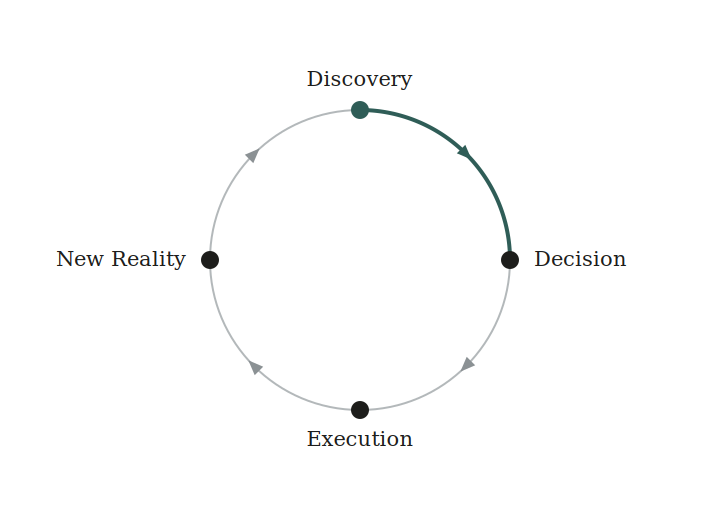
The whole circle is where this series is headed, but this first essay covers only its opening arc — the passage from discovery to decision. Execution, and the new reality it makes, are for later parts.
Four lenses, one war
Turning a finding into a decision raises four questions in particular — and they are not a random list. Three of them are the natural joints of the passage from a finding to an act: what to do, the choice itself; when to decide, and which way, its timing; and where to look and what to make happen, the way you manufacture more evidence when you have too little. The fourth sits just behind the finding and shadows all the others — can we even compute the answer in time? — the question of whether the discovery can be reached at all before the moment to use it has passed.
There is what should we do? — operational research, born when Blackett's scientists, working the same Atlantic as Bletchley, turned convoy records and depth-charge data into better operational choices (Budiansky, 2013). There is when do we decide, and which way? — statistical decision theory, which Turing had touched in Banburismus and which Abraham Wald, at Columbia in 1943, built into a general method of deciding after each new observation whether the evidence was yet enough to act (Wald, 1947). And there is where do we look, and what do we make happen? — intervention, the gardening logic of acting on the world to produce the evidence you lack, which runs on into the modern science of designed experiment and active learning. Behind all three stands the fourth question — can we even reach the answer in time? — and the discipline of computing: not whether an answer exists, but whether you can actually calculate it before the moment to use it has passed. That was the Alan Turing Series' own spine, and the reason the Bombe existed at all.
Where the series goes from here I am leaving open — the number of parts and the choice of cases are not fixed. The only constant is the question it began with: how does a discovery become a decision, and who makes it?
The bunker, again
Back to the 28th of February, 2020: the rain, the stairs down off King Charles Street, a flight to catch. I had come to London to ask whether a machine could discover. I left having stood, without quite realising it, at the place where discovery becomes decision — and walked straight into the question that this series is about.
The machines get better at discovery every month. This series is about what comes after — the older, harder, more human passage from a thing found to a thing done, which does not get easier just because the finding did.
Fifty miles. Two rooms. Between them, the space this series is about.
References
Sources are grouped by the claim they support, so that specific facts can be traced. Where a museum or archive page is cited, it is the most direct public source located; readers who want the underlying documents can follow on to the scholarly works listed.
The February 2020 workshop, the Nobel Turing Challenge, and the closed-loop AI scientist.
- The Alan Turing Institute, "AI Scientist Grand Challenge: Summary of discussion during workshop held in February 2020" (workshop held in London, 26–27 February 2020; co-chairs Y. Gil, R. King, H. Kitano; sponsored by ONR Global). — https://www.turing.ac.uk/research/research-projects/turing-ai-scientist-grand-challenge
The Churchill War Rooms as a decision centre; the Map Room's daily summaries and its collation → options → decision structure; the "Glamour Boys."
- Imperial War Museums, "The Map Room at the Cabinet War Rooms" (the five senior men, the collation → options → decision chain). — https://www.iwm.org.uk/history/the-map-room-at-the-cabinet-war-rooms
- Sky HISTORY, "What really happened inside Churchill's secret War Rooms?" — https://www.history.co.uk/articles/what-really-happened-inside-churchills-war-rooms
Hut 3: fusion and translation of decrypts into intelligence; "headlines" and Churchill's daily box; Hut 3 as an intelligence agency that did not itself command.
- D. Kenyon, Bletchley Park and D-Day: The Untold Story of How the Battle for Normandy Was Won (Yale University Press, 2019).
- Bletchley Park Trust, "Invasion Intelligence" (on Hut 3, headlines, and the material selected for the Prime Minister). — https://www.bletchleypark.org.uk/our-story/invasion-intelligence/
Naval Ultra routed to the Admiralty's Operational Intelligence Centre because it was an operational HQ able to give orders during a battle.
- "Hut 4," Wikipedia (naval section handling; verbatim naval decodes to the NID/OIC). — https://en.wikipedia.org/wiki/Hut_4
Source protection: acting on Ultra without revealing it, including staged "cover" so the enemy blamed another source.
- F. H. Hinsley and A. Stripp (eds.), Codebreakers: The Inside Story of Bletchley Park (Oxford University Press, 1993).
- F. W. Winterbotham, The Ultra Secret (Weidenfeld & Nicolson, 1974), on the Special Liaison Units and controlled dissemination.
Banburismus and the ban / deciban as a measure of the weight of evidence.
- I. J. Good (1979), "Studies in the history of probability and statistics. XXXVII. A. M. Turing's statistical work in World War II," Biometrika, 66(2), 393–396. — https://doi.org/10.1093/biomet/66.2.393
"Gardening": manufacturing cribs by mining chosen areas so the enemy would report them by Enigma.
- "Gardening (cryptanalysis)," Wikipedia. — https://en.wikipedia.org/wiki/Gardening_(cryptanalysis)
Operational research on the Atlantic: convoy size and depth-charge settings under Blackett.
- S. Budiansky, Blackett's War: The Men Who Defeated the Nazi U-Boats and Brought Science to the Art of Warfare (Knopf, 2013). — https://www.penguinrandomhouse.com/books/209799/blacketts-war-by-stephen-budiansky/
Wald's invention of sequential analysis (1943) at Columbia's Statistical Research Group, from a US Navy weapons-testing problem.
- A. Wald, Sequential Analysis (Wiley, 1947; developed 1943 under the Statistical Research Group).
- "Abraham Wald and the Origins of the Sequential Probability Ratio Test," The American Statistician (2025). — https://www.tandfonline.com/doi/full/10.1080/00031305.2025.2604805
The modern echo: a modelling-to-policy reporting line in the COVID-19 response (treated fully in a later part).
- H. Kitano (2025), "Mission-Critical Policy Decisions in a Pandemic: Japan's Use of AI and Complex Systems Simulation in COVID-19 Response," in S. Kurihara (ed.), Social Simulation of COVID-19 with AI in Japan (Springer), pp. 1–17. https://doi.org/10.1007/978-981-96-8066-5_1
Web sources were consulted in July 2026. The "fifty miles" between Bletchley Park and London is a rounded figure: the straight-line distance is about forty-three miles and the road distance about forty-nine, while Bletchley Park's own visitor information gives "just 52 miles"; fifty is used here as the nearest round number.
A note on how this was written
This post is a human–AI collaboration. Hiroaki Kitano is the author; the workshop and the visit to the Churchill War Rooms on 28 February 2020 are his own, and both photographs in the figure are his, taken on site — corrected for perspective and composed into a single side-by-side image with the help of ChatGPT (OpenAI). Claude (Anthropic) was the primary collaborator in drafting and structuring, with Gemini (Google) and ChatGPT (OpenAI) in the loop for framing and cross-checking. Historical claims were checked against the sources listed above; anything not yet fully verified is flagged as approximate. Final editorial judgment is the author's.
The central idea of this essay — that Bletchley Park's work was never only codebreaking, but a whole apparatus for turning findings into decisions — took shape during a visit to Bletchley Park on 6 July 2026, in conversation with the Trust's historians about how the operation actually ran. The author warmly thanks Tilly Davis, Dr David Kenyon, Laura Stoker, and Natalie Askew-Conti of Bletchley Park for their generosity and time, and the Bletchley Park Trust. Dr Kenyon's Bletchley Park and D-Day (2019) informed the account of Hut 3 given here.
See the Lab Notebook for this post for the sources, the verification, and the iteration history.
 Hiroaki Kitano