Machine Traces of Discovery Paths #4 — The Path to CRISPR-Cas9 (Emmanuelle Charpentier), a Convergence Trace
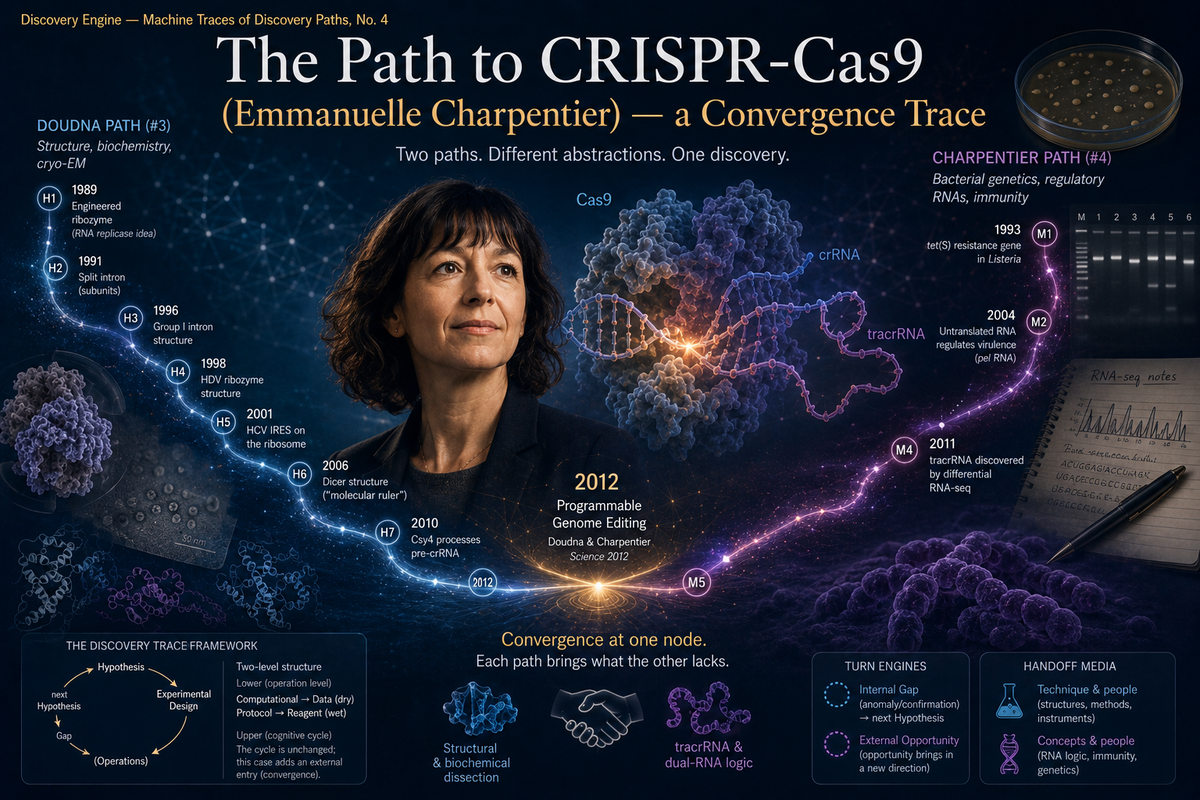
Discovery Engine — Machine Traces of Discovery Paths, No. 4
Disclaimer — Discovery Trace Series. The Discovery Trace series is an experimental series of articles attempting the semi- or fully-automatic reconstruction of the paths to major discoveries. Multiple AI tools have been deployed to reconstruct each "Discovery Path." To evaluate the progress of the technology, an initial set of articles is published prior to rigorous verification, and may therefore contain errors and omissions. Content will be updated as corrections are made, with notes on publication history and a correction log.
Entry No. 3 (https://thediscoveryengine.ai/machine-traces-of-discovery-paths-3-the-path-to-crispr-cas9-jennifer-doudna/) reconstructed the path to CRISPR-Cas9 from Jennifer Doudna's side — nine papers of RNA biochemistry and crystallography, from a 1989 engineered ribozyme to the 2012 enzyme that made CRISPR programmable. This entry reconstructs the same discovery from the other author of that 2012 paper, Emmanuelle Charpentier. It is the series' first convergence trace: two paths, built independently by the same method, that turn out to meet at a single shared node. The point is not to retell the discovery. It is to ask a methodological question the single-path traces cannot — does the shape hold when you approach the same landmark from the opposite direction? — and to see what a discovery looks like when two people arrive at it carrying different things.
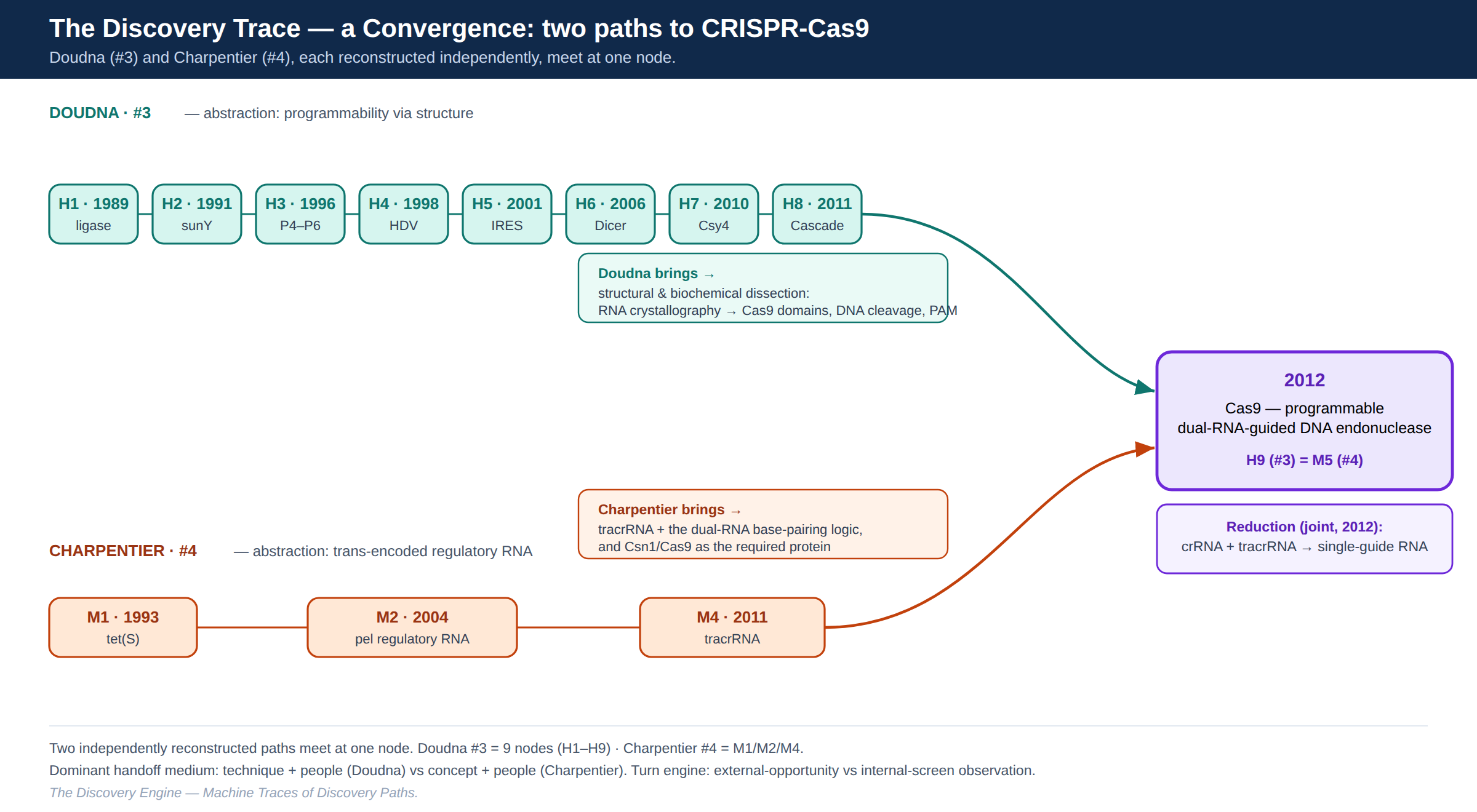
Two paths to CRISPR-Cas9 — Doudna (#3) and Charpentier (#4) meet at the 2012 paper.
The convergence: two independently reconstructed paths dock at one node (H9 = M5). Each side brings a complementary half — structural & biochemical dissection from Doudna, tracrRNA and the dual-RNA base-pairing logic from Charpentier — and the reduction (crRNA + tracrRNA → single-guide RNA) is a joint act.
Why Charpentier, and who else is on the path
A Discovery Trace treats a path as the property of one person; everyone else is an influence or a co-discoverer. On the Doudna trace, Charpentier was a co-discoverer named at the junction. Here she is the subject, and Doudna becomes the co-discoverer — her path is No. 3, and the two are read as companions, not competitors. The CRISPR-immunity pioneers whose work both paths build on — Mojica, who saw that spacers match phage; Jansen, who named the cas genes; Barrangou and Horvath, who showed CRISPR is adaptive immunity; Brouns, Marraffini and Sontheimer, Garneau — are influences on both traces, not nodes on either. And the parallel demonstration of Cas9 as an RNA-guided nuclease by Šikšnys and colleagues, published weeks after the 2012 paper, is exactly that: a parallel, independent arrival, credited as such. Charpentier's own carriers are credited where they hand something forward — Jörg Vogel, whose differential RNA-seq made the key transcript visible, and Krzysztof Chylinski, who appears on both the 2011 and 2012 papers and is the human thread across the junction.
The path, in four moves
Charpentier's route to CRISPR does not begin in RNA at all. It begins in antibiotic resistance. Her 1993 PhD paper (M1) characterises tet(S), a new tetracycline-resistance gene in Listeria monocytogenes, down to its sequence, its reading frame, its ribosome-binding site, and the inverted repeats upstream that hint at how it is regulated. Nothing here touches CRISPR. What it establishes is a way of working: clone a determinant, sequence both strands, read the regulatory detail off the sequence, and reason from homology to mechanism — and a world, the Gram-positive pathogens (Listeria, Streptococcus, Enterococcus) and their mobile genetic elements. That method and that world are what she carries forward. It is an honest, unglamorous origin, and naming it correctly matters: the trace records a technique-and-discipline handoff, not a molecular one.
The turn into RNA comes in 2004 (M2). Working now on Streptococcus pyogenes, her lab shows that a virulence program is governed by an untranslated RNA — that "the untranslated pel RNA and not a translational product of pel RNA functions as a regulator." The finding itself is not the point for our purposes; the lens is. From here on, Charpentier's reflex when she meets an abundant transcript is to ask whether the RNA, rather than any protein it might encode, is the functional actor. That question, installed here, is what will later find tracrRNA.
The discovery node is 2011 (M4). A differential RNA-seq survey of the S. pyogenes transcriptome — the small-RNA hunt that grew directly out of the pel program — turns up an abundant transcript beside the CRISPR array: "differential RNA sequencing of the human pathogen Streptococcus pyogenes uncovered tracrRNA, a trans-encoded small RNA with 24 nucleotide complementarity to the repeat regions of crRNA precursor transcripts." The paper then shows that this second RNA directs crRNA maturation with host RNase III and the CRISPR protein Csn1 — Cas9 — and that all of them are required for immunity. This is the object, and the logic, that Charpentier carries into the collaboration.
The junction, and an honest account of the reduction
The 2012 paper (M5) is the landmark, and it is literally the same document as node H9 on the Doudna trace. What each side brings to it is different, and legible. From the Doudna direction comes the capacity to take the system apart biochemically and structurally — the crystallography-trained instinct that resolves Cas9 into domains, maps the cut, and pins down the PAM. From the Charpentier direction comes tracrRNA, the dual-RNA base-pairing principle, and the identification of Cas9 as the required protein. The famous move of the paper — fusing the two natural RNAs into a single-guide RNA — is the reduction that turns a bacterial immune system into a programmable tool. It is worth being exact about authorship here: that fusion experiment lives in the co-authored 2012 paper, not in any solo Charpentier work. On her axis the reduction reads as natural dual-RNA (discovered) → engineered single guide (jointly). Her contribution to it is not the structural act of fusion but the biological act that made fusion conceivable: establishing that the functional unit is two base-paired RNAs and a single protein, and thus defining the minimal parts list that could then be compressed.
What the second path shows
Three things emerge only because the discovery was traced twice.
First, the handoffs are mirror-consistent. On the Doudna trace, the step into 2012 carries a structural-biochemical capacity; on the Charpentier trace, the step into 2012 carries tracrRNA and the dual-RNA logic. These are not the same thing said twice — they are two different objects that fit together at one node, each accounting for what the other lacks. When two independent reconstructions agree on where the seam is and disagree, complementarily, on what crosses it, that is about the strongest internal evidence a method like this can offer that it is tracking something real.
Second, the turn engines are asymmetric. The Doudna path enters CRISPR through an external opportunity — a collaboration, a problem carried in from outside her own results. The Charpentier path enters through an internal observation — tracrRNA simply appeared in her own S. pyogenes small-RNA screen, next to a locus she had reason to be looking at. The same discovery, entered by opposite kinds of turn. A single-path trace has to pick one story about "how the field turned to CRISPR"; the convergence shows there was no single turn, only two, of different kinds, meeting.
Third, the dominant abstractions are orthogonal. Doudna's path is organised around programmability via structure; Charpentier's around trans-encoded regulatory RNA. Neither is the "real" account. The discovery sits at the intersection of a structural-biochemical way of seeing and a regulatory-RNA way of seeing, and it needed both. That two such different intellectual traditions were required is invisible from inside either one.
A general principle: the convergence trace
The single-path traces in this series make a claim about individuals — that a discovery has a reconstructable structure in one person's work. A convergence trace makes a claim about discoveries: that when a landmark has more than one author, each author arrives along a path with its own abstraction, its own handoff medium, and its own turn engine, and the landmark is the point where those distinct paths become mutually necessary. The method's dominant-handoff and turn-type vocabularies, developed to describe one path, turn out to describe the relationship between paths just as well — Doudna's medium is technique-and-people, Charpentier's is concept-and-people; the reduction is a joint act neither could have performed alone. This is a new kind of object for the series, and it suggests the natural next step for any multi-author discovery: trace each author separately, then read the seam.
None of this settles the human questions that sit outside the papers — why each scientist turned when she did, how the collaboration actually began, who saw what first. Those live in interviews and lectures, and the trace flags them rather than pretending the literature answers them. What the literature does answer, read twice, is the shape: two prepared minds, formed in different disciplines, each carrying exactly the half the other needed, meeting at one experiment. That is not a diminishment of the discovery. It is the most precise thing we can say about how it was made.
This is entry No. 4 of Machine Traces of Discovery Paths and the series' first convergence trace, companion to No. 3 (Doudna https://thediscoveryengine.ai/machine-traces-of-discovery-paths-3-the-path-to-crispr-cas9-jennifer-doudna/). The supporting Lab Notebook — the four-node reconstruction (M1/M2/M4 read at full text, M5 shared with No. 3), the chain, the two-halves account of the reduction, and the coverage record — is the verifiable source document behind this essay.
Lab notebook: https://thediscoveryengine.ai/machine-traces-of-discovery-path-4-lab-notebook/
How to cite
Kitano, H. Machine Traces of Discovery Paths #4 — The Path to CRISPR-Cas9 (Emmanuelle Charpentier), a Convergence Trace, The Discovery Engine (2026)
Hiroaki Kitano ORCID: 0000-0002-3589-1953
Hiroaki Kitano
Published: 17 August 2026