The Discovery Trace - Architectural Implications from iPS Cell
Discovery Engine — Machine Traces of Discovery Paths — Architectural Implications
Disclaimer — Discovery Trace Series. The Discovery Trace series is an experimental series of articles attempting the semi- or fully-automatic reconstruction of the paths to major discoveries. Multiple AI tools have been deployed to reconstruct each "Discovery Path." To evaluate the progress of the technology, an initial set of articles is published prior to rigorous verification, and may therefore contain errors and omissions. Content will be updated as corrections are made, with notes on publication history and a correction log.
The two entries of Machine Traces of Discovery Paths reconstructed one discovery — the path to induced pluripotent stem cells — at two depths. The first read the outside of the papers, their abstracts and reference lists, and recovered four hinge points (https://thediscoveryengine.ai/machine-traces-of-discovery-paths-1-the-path-to-ips-discovery/ and associated Lab Notebook https://thediscoveryengine.ai/machine-traces-of-discovery-paths-1-lab-notebook/). The second read the inside, the full Methods and Results of nine papers, and recovered seventy experiments, the protocol values they printed, and the values they omitted (https://thediscoveryengine.ai/machine-traces-of-discovery-paths-2-the-path-to-ips-discovery-a-comprehensive-analysis-and-reconstruction/ and associated Lab Notebook https://thediscoveryengine.ai/machine-traces-of-discovery-paths-2-lab-notebook/). The second entry also made visible something the first could not see: that the path is not only a chain of ideas but a chain of physical reagents, each experiment's product becoming the next experiment's starting material.
That observation raises a more general question. If a discovery path has a structure — reagents handed forward, hypotheses tested and revised, results read and re-read — can that structure be written down in a form precise enough for a machine to take as input? Not a narrative of the discovery, and not a citation graph of who influenced whom, but a representation of how the work was actually carried out, at the level at which it could be re-run. This entry steps back from the single reconstructed path to ask what representation any such path would need, and proposes a first shape for it. It is a proposal, not a finished formalism; the point is to put a structure on the table concrete enough to be argued with, and to mark clearly where it is still open.
We call it a Discovery Trace.
Two levels
The central claim is that a discovery path has two levels, and that they do different kinds of work.
The lower level is where operations act on objects. It has two pairs, one dry and one wet:
- Computational → Data. A computational operation — a BLAST search, a digital differential display, an analysis of variance, a clustering — acts on data. Its object is information.
- Protocol → Reagent. A wet-lab protocol — a PCR, a culture, a gene targeting — acts on a reagent. Its object is physical matter.
The two pairs are the same relation in two media: an operation, and the object it operates on. In the dry pair the object is information; in the wet pair it is matter. A single experiment usually runs both — a computational step to decide what to make or measure, a protocol step to make or measure it — and hands forward both a piece of data and a physical reagent.
The upper level is a cognitive cycle. It does not act on objects directly; it decides which operations the lower level should run, and reads what they return. It turns:
- A Hypothesis — a testable prediction.
- Experimental Design turns the Hypothesis into a sequence of operations that would test it — which operations, in which pairs, in which order.
- The operations run; results come back up.
- Interpretation reads the results and checks them against the Hypothesis.
- The relation between what was predicted and what came back is the Gap — a broad term, with more than one kind inside it, discussed below.
- The Gap generates a new Hypothesis, and the cycle turns again.
The two levels communicate by request and result, and two of the cycle's steps sit on that boundary as translations in opposite directions. Experimental Design translates downward — a hypothesis, stated in the language of expectation, into a plan of operations the lower level can run. Interpretation translates upward — the data and reagents the operations return, back into the language of the hypothesis. Between them the lower level does the work: which pair it is asked for varies by hinge — a step that identifies candidate genes by digital differential display is dry-dominant; a step that builds a knockout by gene targeting is wet-dominant; most steps alternate, a computational operation narrowing a space and a protocol acting in it. Experimental Design is the step that decides that sequence.
Naming Experimental Design as its own step matters because it is not automatic. A hypothesis does not come with its test attached; the same prediction can be probed by different sequences of operations, and choosing one is a real act. It is, in fact, precisely the object the first stage of automated discovery would have to produce: an executable plan. A discovery path that records only its hypotheses and its results, with the design step left implicit, has left out the step where the thinking became an experiment.
The Gap deserves more than a one-line definition, because it is the term that carries the most weight and it is easy to flatten. It is tempting to define the Gap as the difference between the prediction and the result — but that definition only holds for one kind of Gap. It works when the prediction and the result live on the same axis and a difference can be taken: a predicted editing efficiency against a measured one, a predicted colony count against an observed one. Call that a quantitative-deviation Gap. Much of a path is made of these, and they are the kind a machine reads most easily, because the difference is a number.
But the Gaps that bend a path are usually not of this kind. When the 1995 transgenic was built to lower LDL and returned liver tumours, the result was not a large difference from the prediction — cancer is not a value on the cholesterol axis. It was an observation from outside the space the hypothesis had defined. Call that an unanticipated-observation Gap: the result does not sit where the prediction can be compared to it at all; it appears on an axis the prediction never named. The 2000 knockout is the same kind — translation was normal, as one might predict, but the cells could not differentiate, which the experiment was not asking about. These are the turns where the path changed direction, and they are not differences that a subtraction could have produced.
And a third kind: when a prediction simply holds, the Gap is a confirmation — small or none, the result sits where it was expected, and the turn consolidates rather than redirects. The 2003 catalogue and the 1994 cloning are confirming turns.
So the Gap is not one thing with a size; it is a broad category with internal structure. Size is one axis within it — a quantitative-deviation Gap can be large or small — but the more consequential distinction is in kind: a numeric deviation on a known axis, an observation from off the predicted space, or a confirmation. This matters for what follows, because it is the unanticipated-observation Gap — the one that cannot be written as a difference — that does the most to drive a discovery, and it is exactly the kind hardest to formalise. A schema can hold a delta; it has no natural field for a result the hypothesis did not know to look for.
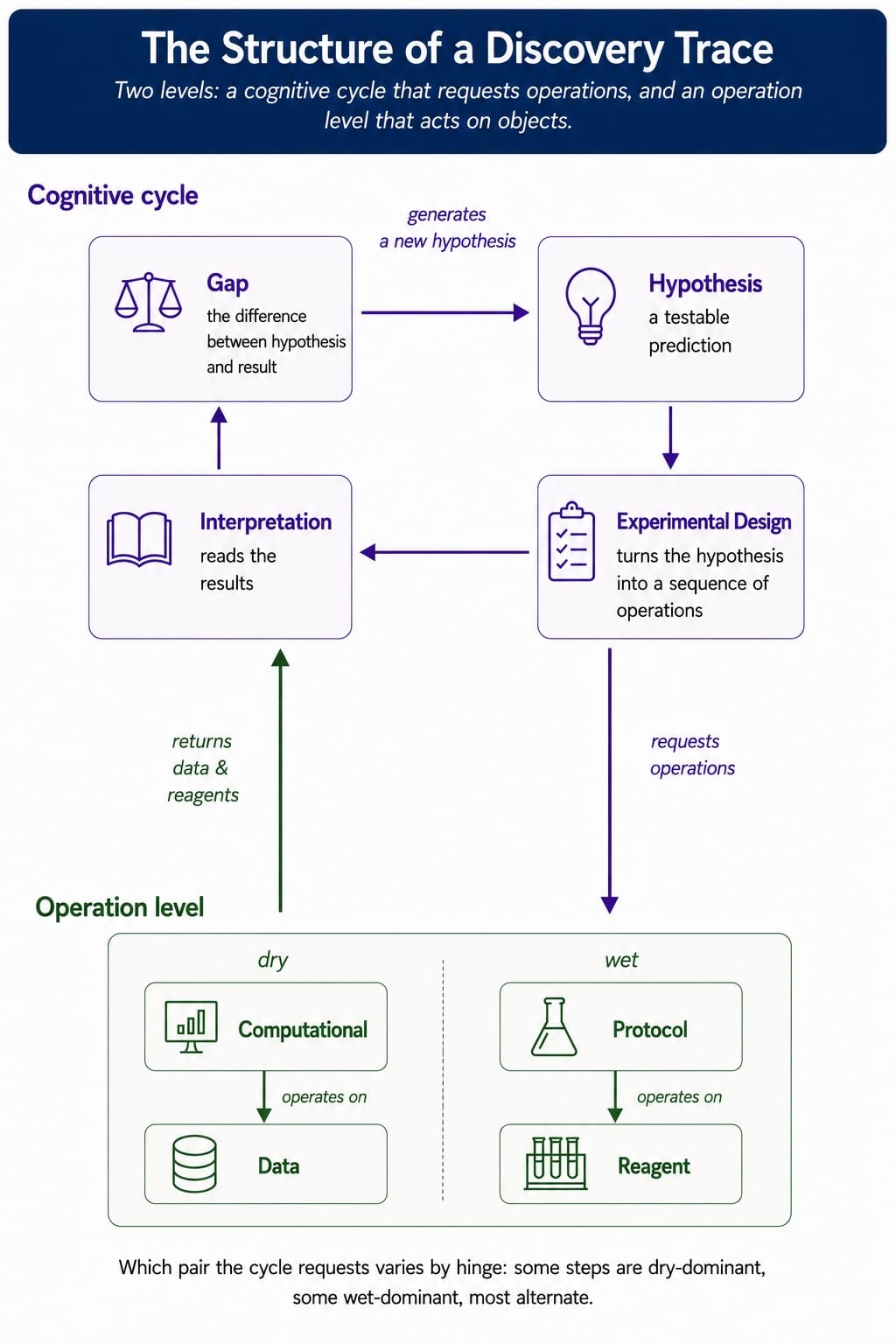
The structure of a Discovery Trace: a cognitive cycle over an operation level
The upper level is a cognitive cycle — Hypothesis, Experimental Design, Interpretation, Gap — that turns and generates the next hypothesis. The lower level is a pair of operation→object channels, dry (Computational→Data) and wet (Protocol→Reagent). Experimental Design requests operations of the lower level; the results return to Interpretation. Which pair a given hinge calls on varies.
Where this sits among existing work
Little of the two-level structure is new on its own, and it is worth saying so plainly, because the contribution is not the layers but the joint between them. This is an architecture proposal, not a claim of novel parts; where a part already exists, the right move is to adopt it and be exact about what is added.
The lower level is, in effect, an existing kind of object. Standards for machine-readable experimental records already exist — the Allotrope Simple Model represents laboratory operations and their results in a structured, ontology-backed format across dozens of analytical domains (Allotrope Foundation, 2023), and vendors describe such formats explicitly as an intermediate representation for downstream computation (TetraScience, 2025). The Computational→Data and Protocol→Reagent pairs are that same operation-on-object relation. What the Discovery Trace adds to the lower level is not a new formalism but a single requirement — completeness — and the stance that follows from it: that a missing parameter is an error to be corrected, not a tacit part to be accommodated.
The upper level, too, has antecedents. Modelling discovery as a search with distinct phases goes back at least to Scientific Discovery as Dual Search (Klahr & Dunbar, 1988), in which reasoning moves between a hypothesis space and an experiment space. The cognitive cycle here is a near relative. But the difference is the point of the whole structure: SDDS's two spaces are both cognitive — the search happens entirely in the scientist's head, over hypotheses and over experiments-as-plans. The two levels here are not two cognitive spaces; they are a cognitive level and a material one, and what joins them is not search but translation — a hypothesis turned into operations on real matter and data, and their return turned back into meaning. That translation across a cognitive–material boundary, rather than search within the cognitive, is where the genuinely new claim of this piece lives, and it is the part the rest of the article is about.
Framed this way, the recent autonomous-discovery systems locate themselves naturally. Systems that generate and run computational experiments (Lu et al., 2024; Yamada et al., 2025), that execute chemistry on real hardware (Boiko et al., 2023), or that generate hypotheses for human labs to test (Gottweis et al., 2025) each automate some portion of one or two of the translations, in narrow settings — an observation returned to below, once the translations have been named. The field's own assessment is that hypothesis formulation remains the least automated part of the process (Jacobsson, 2026); the structure here is an attempt to say precisely where, in the anatomy of a path, that difficulty sits.
The path to iPS, read as a Discovery Trace
The structure is easier to see against the discovery it was drawn from.
At the 1995 hinge, the Hypothesis was that overexpressing the APOBEC-1 editing enzyme in the liver would lower LDL cholesterol. Experimental Design turned that into a plan: build transgenic animals expressing the enzyme in liver, then measure their lipoproteins. The lower level ran the wet pair — a Protocol (build the transgenics) acting on a Reagent (the expression construct from the year before), producing new reagents (the transgenic lines) and Data (lipid measurements, and, unbidden, liver histology). Interpretation read the histology: not a failed lipid experiment but liver tumours in every line. The Gap between the prediction (lower LDL) and the result (cancer) was large, and it generated a new Hypothesis — that the enzyme was mis-editing other messages, and that one of them mattered for growth. That new hypothesis is the 1996 and 1997 work.
At the 2003 hinges, the cycle leaned on the dry pair, and the Gap was small. The Hypothesis was that genes expressed specifically in ES cells hold the key to pluripotency; the operation was a Computational one — digital differential display over EST libraries — acting on Data, returning a catalogue of ES-cell-specific candidates. Only then did the wet pair take over, testing candidates one at a time by targeting. The prediction largely held: the genes were there to be catalogued, as expected. This is a confirming turn, not a redirecting one — dry-led where 1995 was wet-led, small-gap where 1995 was large — and it consolidates the ground the next hinge will build on. One incidental finding mattered later: among the catalogued genes, Fbx15 proved dispensable, and a dispensable gene whose locus can be switched without harm makes a usable selection marker.
The 2006 hinge is really two turns. In the first, the cycle ran the wet pair at scale — twenty-four factors introduced together into a reporter line — testing whether a combination of ES-cell factors could induce pluripotency. It could: colonies formed. But removing factors one at a time returned a result that contradicted a natural expectation — the ten-factor pool produced more colonies than all twenty-four. The Gap there, more is not better, revealed that the full set carried inhibitory factors. That gap set up a second turn of a different kind. Where the first turn tested a hypothesis, the second optimised: from the ten necessary factors, a leave-one-out search converged on the minimal set of four. Verification and optimisation are different cognitive operations — one asks whether a prediction holds, the other searches a space of combinations for a smallest sufficient set — and a discovery path can contain both. The optimisation turn is worth marking, because searching a combinatorial space is exactly the kind of operation that automation performs well.
Read this way, the path is a sequence of turns of one cycle, each turn requesting operations of the lower level and reading what they return. The whole path, turn by turn, is shown below.
The path to iPS, turn by turn
The figures that follow read the entire path from the 1994 cloning of the editing enzyme to the 2006 four-factor result, one turn of the cycle at a time. They are worth reading as a set, because the set shows what a single turn cannot: that the operation level a turn calls on varies — some turns are wet-led, some dry-led, some use both; that the Gap varies in size — some turns bend the path, others confirm and consolidate; and that the kind of turn varies — the first builds tools, most test hypotheses, the last optimises. The path is not a uniform chain of identical steps. It is one cycle, turning differently each time.
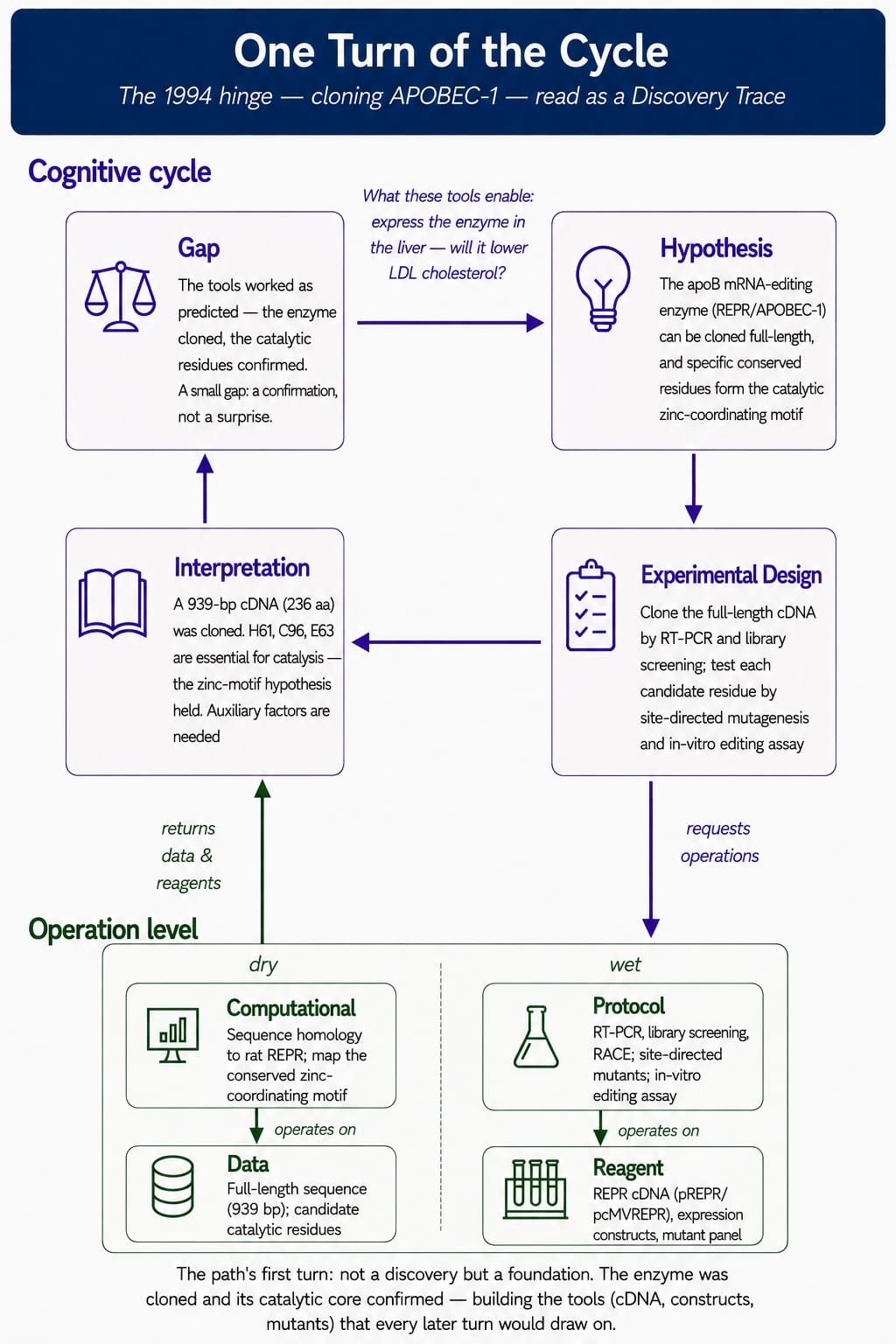
The 1994 hinge — cloning APOBEC-1
1994. A foundation, not a discovery: the enzyme is cloned and its catalytic core confirmed, building the reagents every later turn will draw on. The Gap is small — the tools worked as predicted.
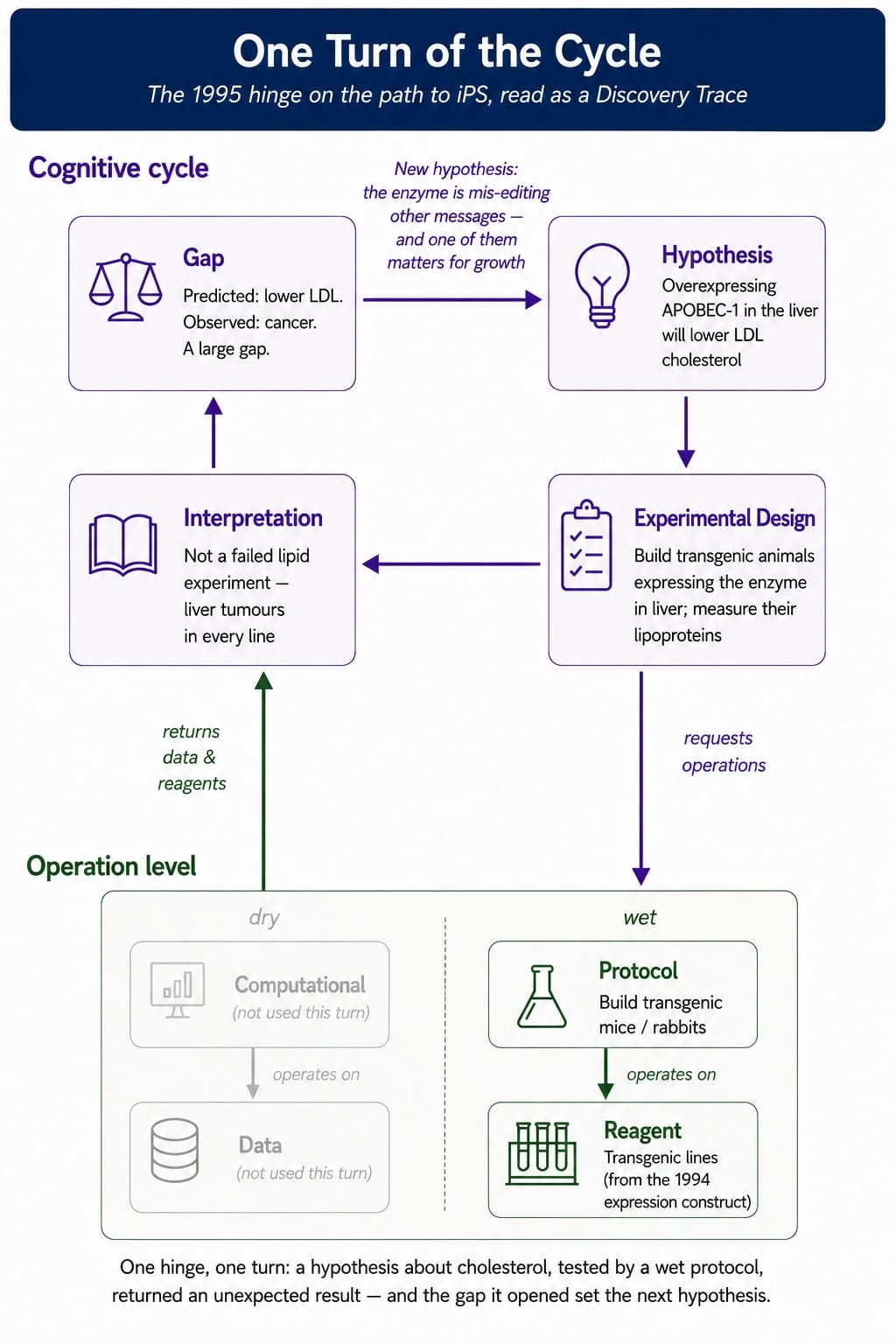
The 1995 hinge — the transgenic that produced cancer
1995. Wet-led, large Gap. A prediction about cholesterol returned liver tumours — and the gap it opened split into two questions.
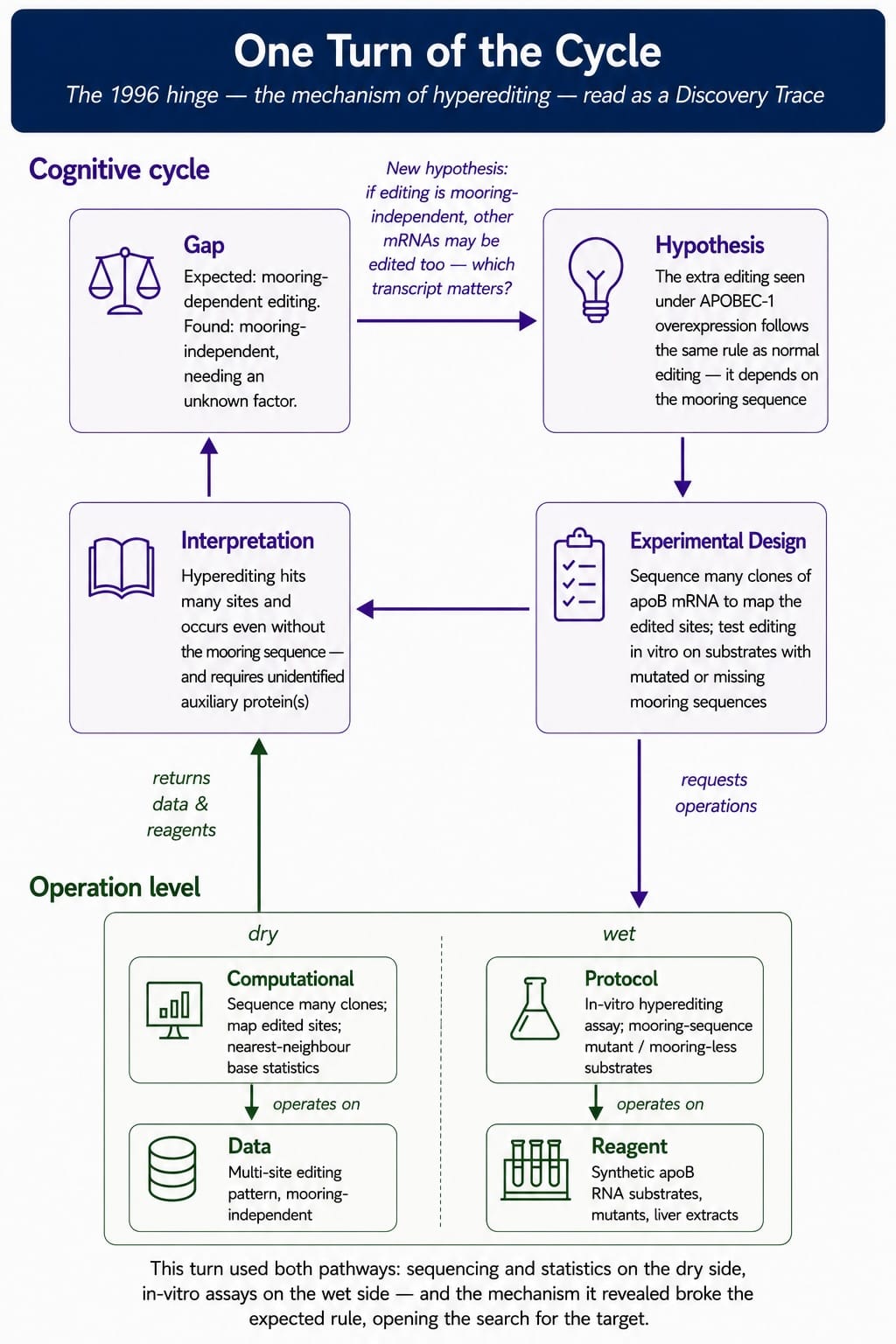
The 1996 hinge — the mechanism of hyperediting
1996. Both pairs active. One branch of the 1995 gap: the mechanism of the extra editing proved mooring-independent and needed an unknown factor.
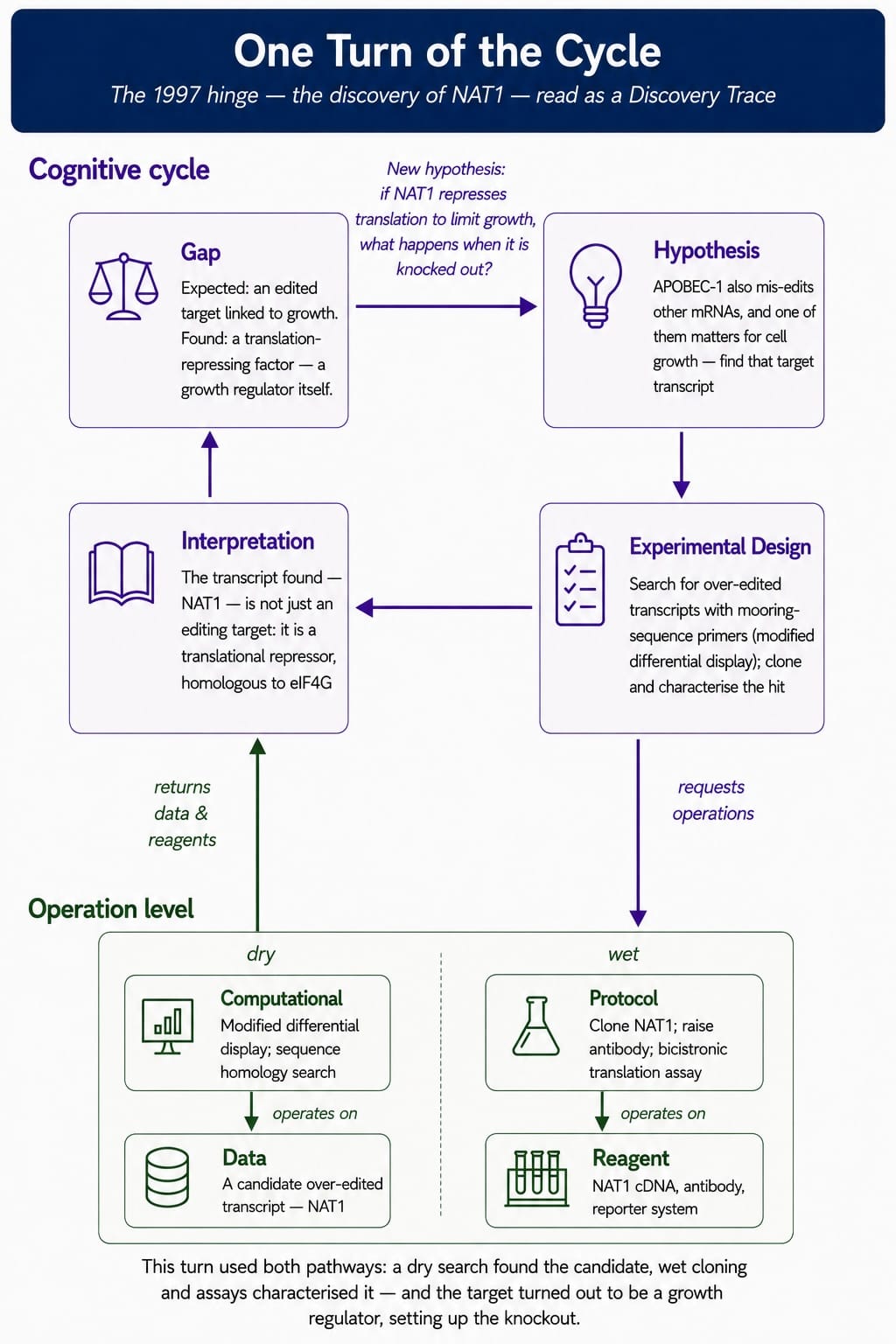
The 1997 hinge — the discovery of NAT1
1997. Both pairs active. The other branch of the 1995 gap: the search for an edited, growth-relevant transcript found NAT1 — a translational repressor.
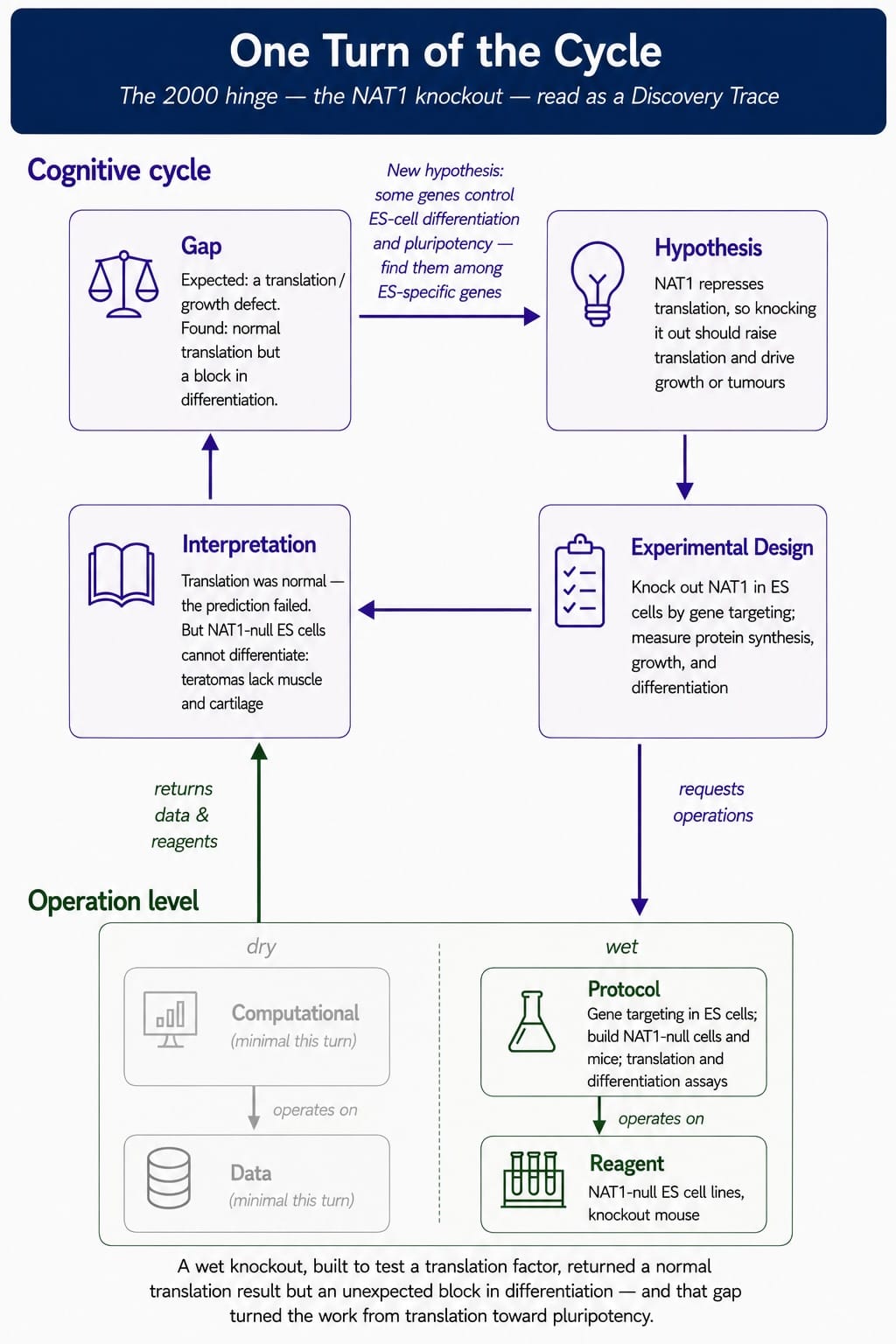
The 2000 hinge — the NAT1 knockout
2000. Wet-led, large Gap. The knockout's translation was normal, but the cells could not differentiate — and the path turned from translation toward pluripotency.
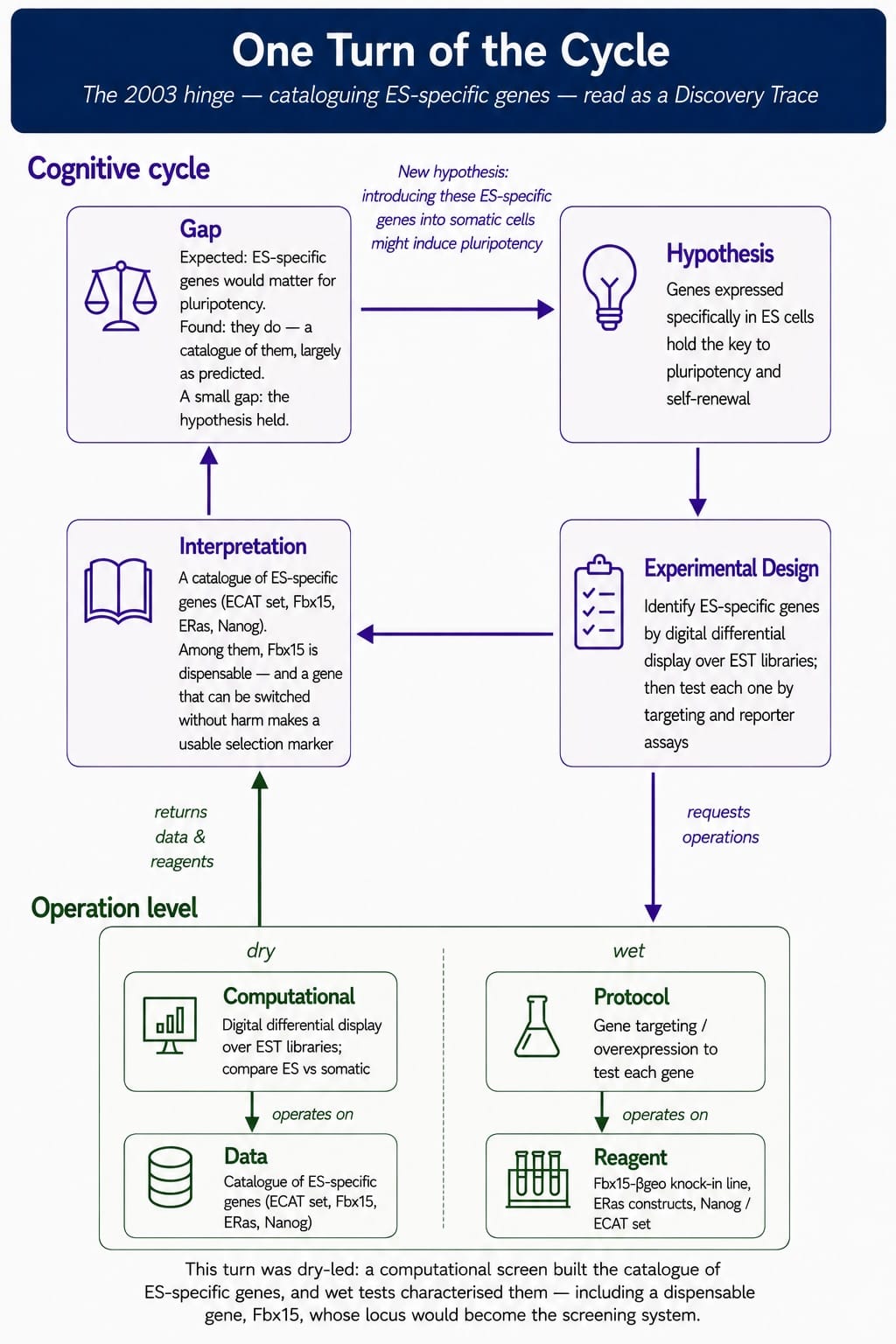
The 2003 hinge — cataloguing ES-specific genes
2003. Dry-led, small Gap. A computational screen catalogued the ES-specific genes largely as predicted — a confirming turn, and the one that supplied the candidate factors.
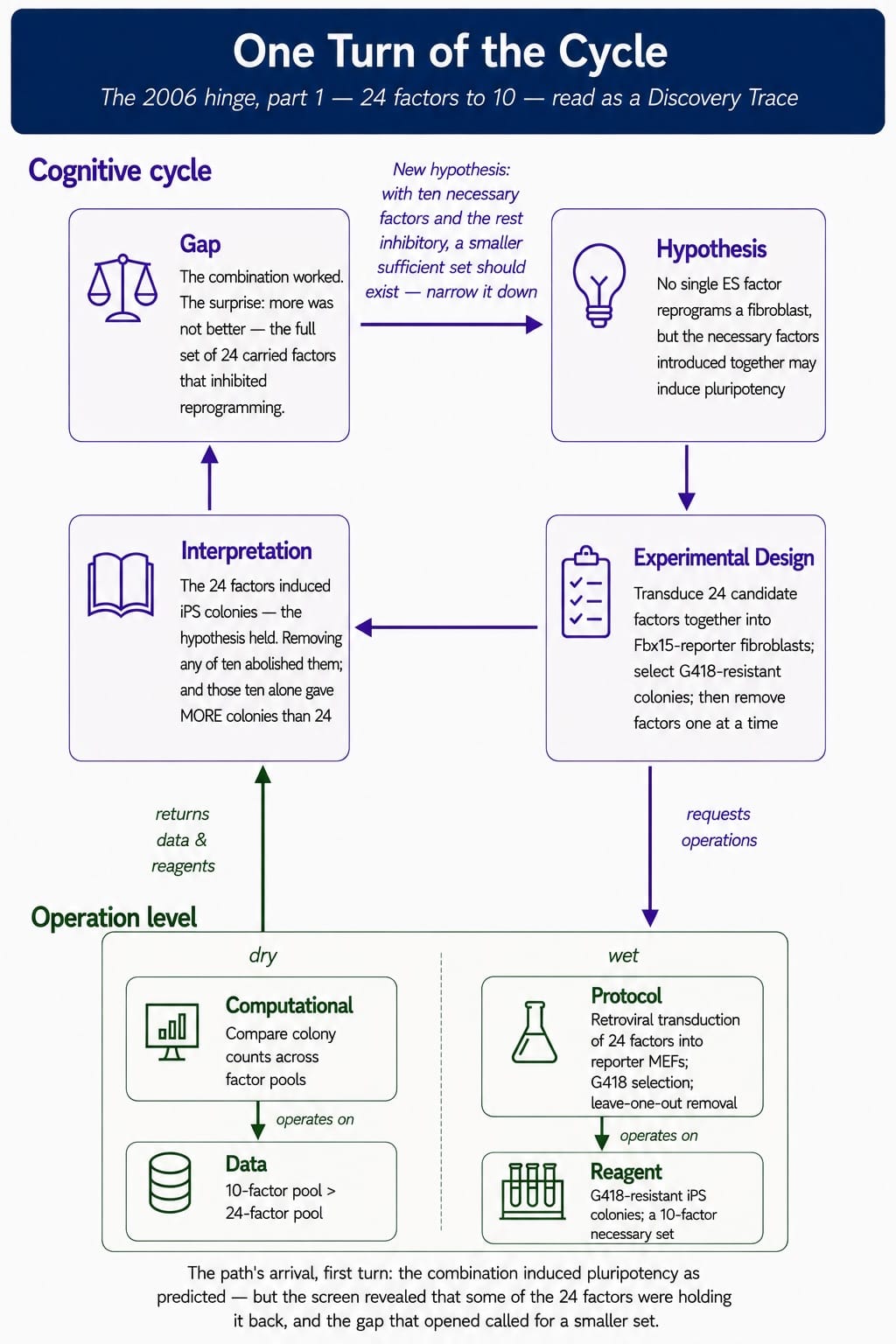
The 2006 hinge, first turn — 24 factors to 10
2006, first turn. Verification. The combination induced pluripotency — but the screen found that ten factors beat twenty-four; some were inhibitory.
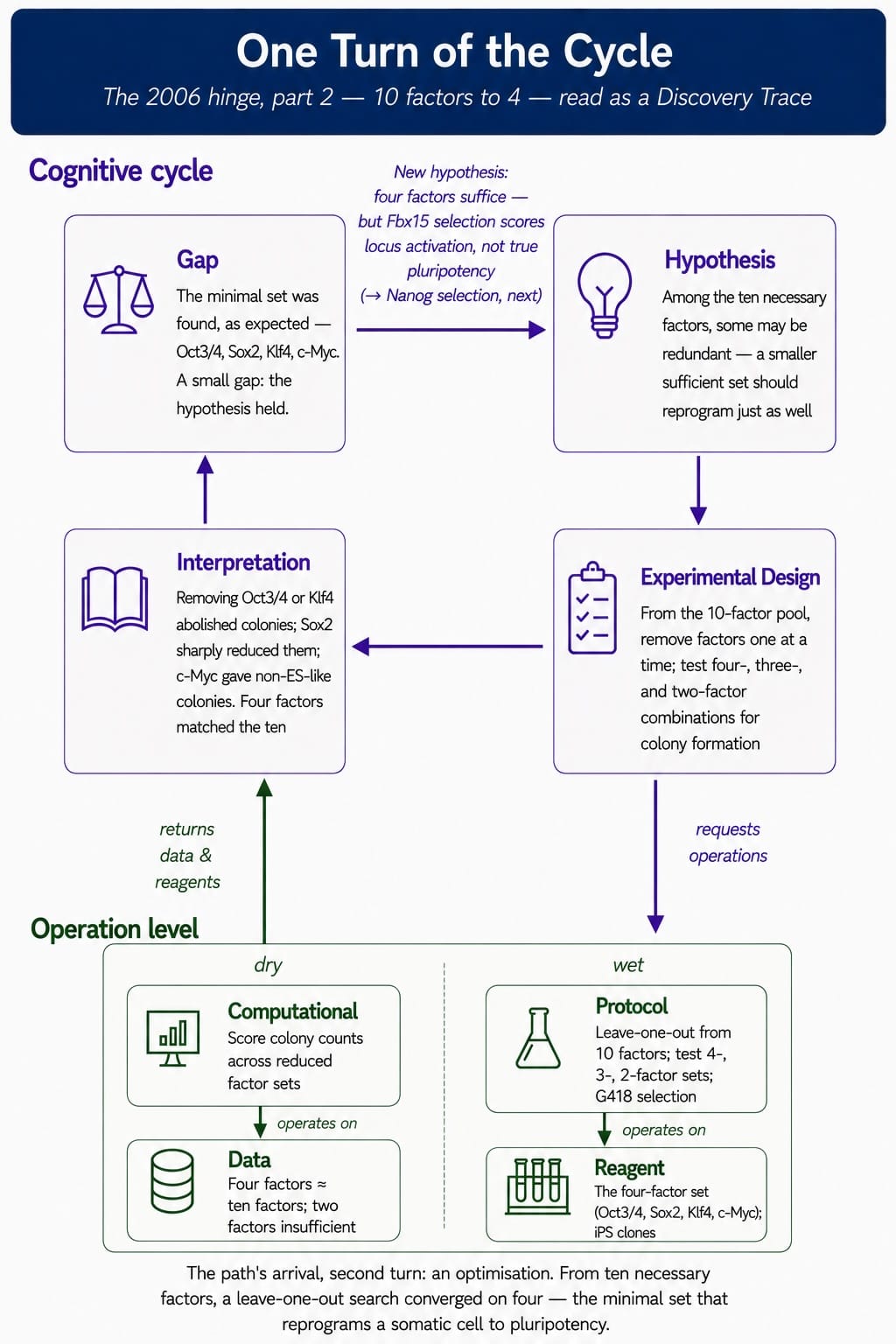
The 2006 hinge, second turn — 10 factors to 4
2006, second turn. Optimisation. A leave-one-out search over the ten necessary factors converged on the minimal set of four.
Each single-turn figure shows the inside of one cycle. What it cannot show is how the turns connect across the path — and the connections are not a straight chain. One turn's Gap can open more than one question; the 1995 gap opened two, pursued in 1996 and 1997. The next figure reads the same path a second way: not as reagents passed forward (the companion figure in Machine Traces #2 does that) but as a hypothesis evolving, branching, and rejoining.
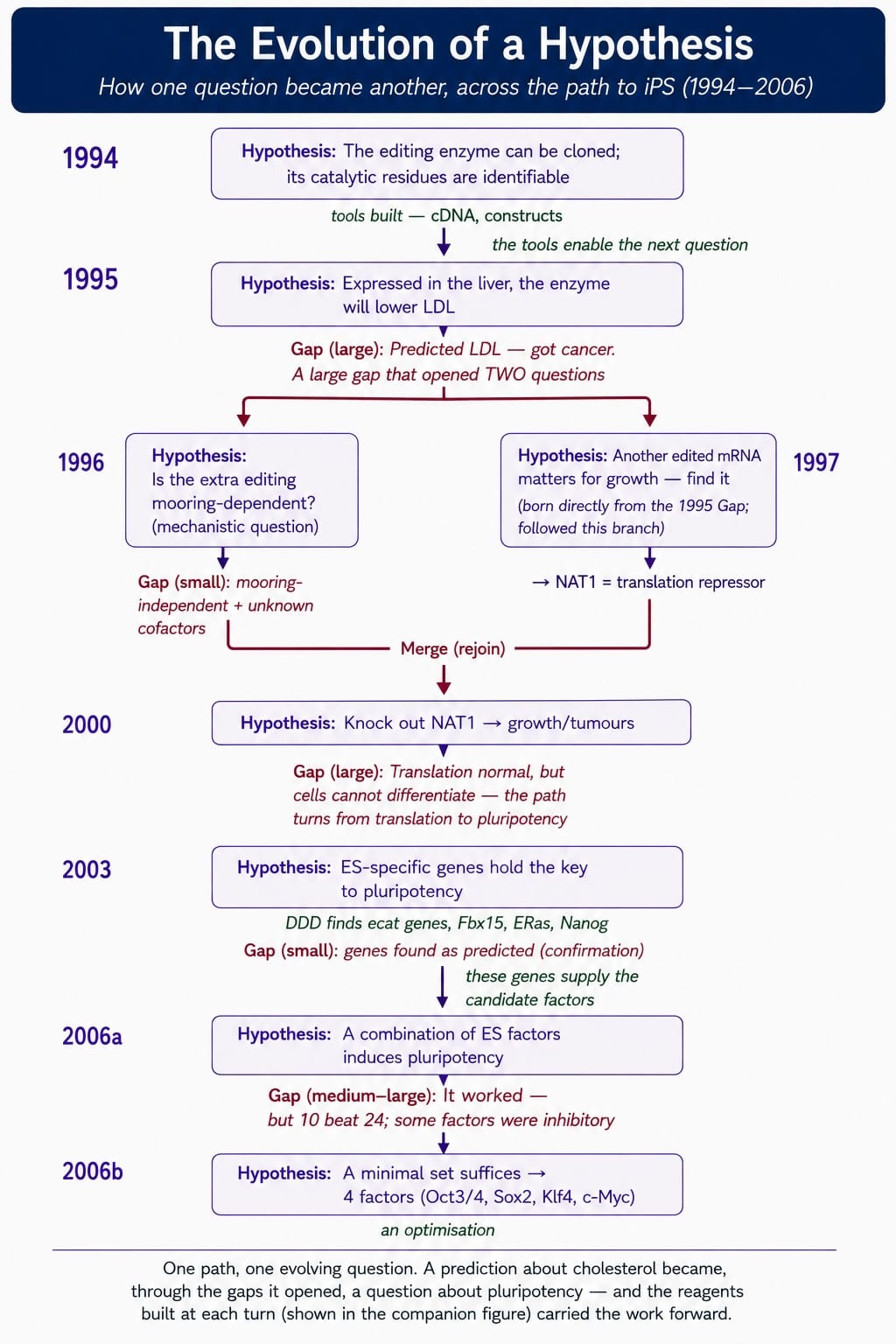
The evolution of a hypothesis across the path to iPS
The path as one evolving question. A prediction about cholesterol became, through the gaps it opened, a question about pluripotency. The large gaps (1995, 2000) are where the path changed direction; the 1995 gap branched into a mechanistic question and a target question that later rejoined.
What the lower level must be
There is a requirement on the lower level that is worth stating plainly, because it is a requirement and not an observation: the operation level must be completely recorded and executable. Every computational operation, with its parameters; every protocol, with its quantities; every object, with its state — all of it should be explicit, to the point where the step could be re-run.
This is a normative claim about what a Discovery Trace should be, not a description of what published papers contain. Papers routinely omit these things — the second Machine Traces entry found that across nine papers the full composition of the ES-cell culture medium is stated not once, and counted 104 items absent in total. But those omissions are not a property of the operation level to be accepted and built into the structure. They are errors to be corrected — gaps in the record that a Discovery Trace must fill, not features it must accommodate. A protocol that cannot be re-run is an unfinished protocol, not a protocol with a tacit part.
The two attitudes matter because they point in opposite directions. If missing values are treated as an inherent tacit layer, the structure normalises them, and the record stays unrunnable. If they are treated as errors, the structure obliges itself to fill them — which is exactly what the [S] tags in the second entry did, supplying period-standard values for what the papers left out. The lower level of a Discovery Trace is, by definition, complete; where a real reconstruction falls short of that, the shortfall is measured and marked, not absorbed.
Recording what the record omits
Marking it requires one piece of bookkeeping. Because real reconstructions are built from papers that do omit things, a Discovery Trace has to record, for each item at the operation level, whether the source actually described it. We tag an item Undescribed when the source does not state it and its value must be supplied from standard practice.
Undescribed is not a ninth kind of thing alongside the operations and objects. It is a status attached to items that are already in the structure — a flag on a protocol parameter or a computational setting, not a component of the path. But it is a status worth aggregating: the count of Undescribed items in a trace measures how far the published record falls short of an executable one. The 104 of the second entry is that count for the iPS path. As the Undescribed items are filled — with explicit provenance for each supplied value — the count falls, and the lower level approaches the completeness the structure requires of it. Undescribed is the visible distance between the norm (a lower level that can be re-run) and the reality (a paper that cannot).
Where the structure is still open
The two-level structure is a proposal. One thing about it is genuinely unsettled; a second is settled here but worth stating as the structure's centre of gravity.
The unsettled thing is whether the layer set is right — whether these are the components, at this granularity, or whether some should be merged or split. Other candidates present themselves. A constraint layer: why NAT1 and not another gene — the need for an independent laboratory, the technology available at the time. An instrument layer: what a given decade made possible at all. We have left these out on the judgement that they are absorbed by the components already named — a constraint is a factor in which Hypothesis is chosen; an instrument is a Computational or Protocol operation that has become available. But this is a judgement, not a proof. The correct set is an empirical question, and one case cannot answer it.
The second point is sharper, and it concerns where the difficulty in a discovery path actually lives. The requirement on the lower level was that it be completely recordable and executable; its omissions are errors to fix, not obstacles in principle. If that requirement holds, then the hard parts of a discovery are not in the operations at all — they are the translations on the cognitive side, the steps where one language is turned into another and the same input admits more than one output. They sit in the upper cycle, and they come in a symmetric arrangement: two design acts and two acts of sense-making, one of each on the way down and on the way up.
Going down, the cycle translates a hypothesis into operations. Going up, it translates what the operations return into a Gap, and the Gap into the next hypothesis. Naming Experimental Design as a distinct downward step — because a hypothesis does not come with its test attached — forces a matching observation on the way up: reading results is not automatic either, and it too divides into a design act and an act of sense-making.
The first translation is Experimental Design — turning a hypothesis into a sequence of operations. The same hypothesis can be tested many ways, and the choice of one plan over another is not derivable from the hypothesis alone. This is the object the first stage of automated discovery must generate.
The second is its upward mirror, Interpretation Design — the choice, made before the results are read, of what to read and by what criterion: which measurement will stand for success, which statistic will be trusted, what will count as the signal. This is not the reading itself; it is the decision that fixes what the reading can see. It is as consequential as Experimental Design, and as non-automatic — the same results admit more than one thing to measure, and choosing one is a real act. The whole iPS screen rested on one such decision: to let G418 resistance at the Fbx15 locus stand for the acquisition of pluripotency. The second Machine Traces entry showed the cost of that choice — the proxy and the state it stood for had come apart, and three factors could switch on the Fbx15 locus without producing genuine pluripotency. The criterion was set before the reading, and it shaped what the screen could and could not see. We raise Interpretation Design to a step of its own, symmetric to Experimental Design, on the same logic that justified naming Experimental Design: if translating down is non-trivial enough to name, so is translating up. (The structure figure above draws only the downward design step; it is an early, simplified view, as the concept of Interpretation Design is still in its infancy and not clearly defined.)
The third is Interpretation — turning the results, once the criterion is fixed, into meaning. The same data admit more than one reading, and the reading taken directs everything downstream. In 1995 the liver histology could have been read as a nuisance side effect; reading it as a cancer question is what opened the next four years of work.
The fourth is the step from a Gap to the next Hypothesis. A Gap — of whichever kind, a numeric deviation or an observation from off the predicted space — does not, by itself, say which new Hypothesis to form. The same Gap admits several next moves; in 1995 the tumours could have been pursued as a transgene insertion artefact, or as apoB48 overproduction, and the papers explicitly ruled those out before settling on mis-edited messages. Something directs the Gap toward one next Hypothesis rather than another — background knowledge, a sense of which question is tractable, an analogy to a Gap resolved before — but we cannot yet say what that something is, whether it is a single factor or several, or whether it can be recorded at all. This is the one translation with no design-act mirror: the two design acts (down and up) choose how to test and how to read, and the two sense-making acts (Interpretation, and the turn from Gap to next Hypothesis) draw meaning and direction from what came back. Of the four, this last is the one that sets a genuinely new direction, and the least reducible.
These four are where the tacit genuinely lives. The lower level can be made complete. But the translations above it — two of design, two of sense-making — may be irreducibly hard to record, and they are almost certainly the deepest frontier for any attempt to automate discovery. The turn from Gap to next Hypothesis is the same act that Can a Machine Connect Distant Dots? (https://thediscoveryengine.ai/connecting-distant-dots/) took up from the front: the generation of a redirecting framing. Here it appears from the other side — not as the first spark of a discovery, but as the turn of a cycle already in motion.
What would make it an engine
The reason to give a discovery path this shape is the same reason the Machine Traces series reconstructs paths at all. The platforms that automate parts of experiments — cloud labs, autonomous optimisation, LLM-driven agents — execute a protocol a human designed or search a space a human defined. What they take as input is a runnable specification. A discovery path recovered from the literature is not yet one; it is a narrative, with the reagents implicit, the operations under-specified, and the record incomplete. A Discovery Trace is an attempt to name the parts that specification would need: the operations and their objects, complete and executable; the cognitive cycle that ordered them; and, marked honestly, the places where the record still falls short and the places where the structure itself does.
But naming the parts also locates the work that remains, and that is the more useful thing the structure does. If the lower level can be made complete — and the claim here is that it can, that its omissions are errors and not an inherent tacit layer — then what is left unautomated is not the operations but the four cognitive translations above them. This matches where the field actually stands. Existing systems have automated mostly the dry side of the operation level and the optimisation kind of turn: an agent that searches a space of computational experiments, or a self-driving platform that runs a reaction it was pointed at. Even the most capable of them touch the four translations only partially. Experimental Design is generated by machine in narrow, well-posed settings. Interpretation Design, Interpretation, and above all the turn from Gap to next Hypothesis remain, in the systems that exist, human acts — the direction-setting done by a person choosing which result to pursue. The formulation of hypotheses, as the field itself observes, is still where automation stops.
So the structure suggests a definition. A Discovery Engine is not a platform that runs experiments; those exist, and they automate a fragment. It is the thing that would make the four cognitive translations tractable at industrial scale — that would take the two design acts (how to test, how to read) and the two acts of sense-making (what the results mean, and which question to ask next) and make them reliable, inspectable, and repeatable across many paths at once, rather than performed once by one scientist on one problem. Three of the four may yield to that; the fourth, the turn from a Gap to the next Hypothesis, is the one this series keeps arriving at from both directions, and the one least certain to yield. Whether it can be made tractable at scale is, in the end, the question of whether discovery can be engineered at all. Naming the translation is the first step toward finding out.
It is a first shape, drawn from one discovery. Whether it holds — whether the two levels and their components are the right ones — is a question the next case will begin to answer.
References
Allotrope Foundation (2023). Allotrope Simple Model (ASM). allotrope.org/asm.
Boiko, D. A., MacKnight, R., Kline, B., & Gomes, G. (2023). Autonomous chemical research with large language models. Nature, 624, 570–578.
Gottweis, J., Weng, W.-H., Daryin, A., et al. (2025). Towards an AI co-scientist. arXiv:2502.18864.
Jacobsson, T. J. (2026). AI-generated hypotheses and the emergence of autonomous scientific discovery. ACS Materials Letters, 8(6), 1457–1464.
Klahr, D., & Dunbar, K. (1988). Dual space search during scientific reasoning. Cognitive Science, 12(1), 1–48.
Lu, C., Lu, C., Lange, R. T., Foerster, J., Clune, J., & Ha, D. (2024). The AI Scientist: Towards fully automated open-ended scientific discovery. arXiv:2408.06292.
TetraScience (2025). Intermediate Data Schema (IDS). tetrascience.com.
Yamada, Y., Lange, R. T., Lu, C., et al. (2025). The AI Scientist-v2: Workshop-level automated scientific discovery via agentic tree search. arXiv:2504.08066.
This is the Architectural Implications entry of Machine Traces of Discovery Paths*. Where the numbered entries reconstruct a single discovery path — #1 and #2 the path to induced pluripotent stem cells, a later entry a second path — this one steps back from the individual paths to ask what representation they share, and proposes a structure to be tested as further paths are reconstructed.*
Hiroaki Kitano
How to cite
Kitano, H. (2026). The Discovery Trace — Architectural Implications 1, Machine Traces of Discovery Paths, The Discovery Engine .
ORCID: 0000-0002-3589-1953
https://orcid.org/0000-0002-3589-1953
First published: August 14, 2026